Botox for Brain Tumour Headaches?
Botox has become so connected to migraine treatment over the last few years, that we may be forgetting its possible value for other headaches.
Two patients with cancer were recently treated at the MD Anderson Cancer Center. Both had brain tumours, though of different types.
After Botox injections both patients experienced fewer headache days, shorter headaches, and less intense headaches. There were no complications, and quality of life improved.
Dr. Alexander Mauskop of the New York Headache Center comments:
It is not surprising that Botox could help headaches caused by a brain tumor. The brain itself is not pain-sensitive – neurosurgeons can cut it in an awake patient without causing any pain. Most of the pain originates in the brain covering called meninges which are innervated by the trigeminal nerve and which can be stretched and irritated by a tumor. The trigeminal nerve also provides sensation over the face and the anterior part of the head. Botox works by reducing pain signals sent from the trigeminal nerve endings to the brain.
Botox for brain tumor headaches?
The end of the story is that doctors can explore the use of Botox (onabotulinum toxin A) for headache and migraine symptoms that may have a variety of causes. The authors of this study conclude: “With careful dose and injection site adjustment based on tumor location, use of Onabotulinum toxin A injections is a safe practice in patients with diagnosis of brain tumor headaches.”
For the study abstract, see Use of Onabotulinum Toxin A as Ambulatory Treatment of Brain Tumor Headaches in 2 Ambulatory Patients at MD Anderson Cancer Center: A Retrospective Chart Review (bottom of page).
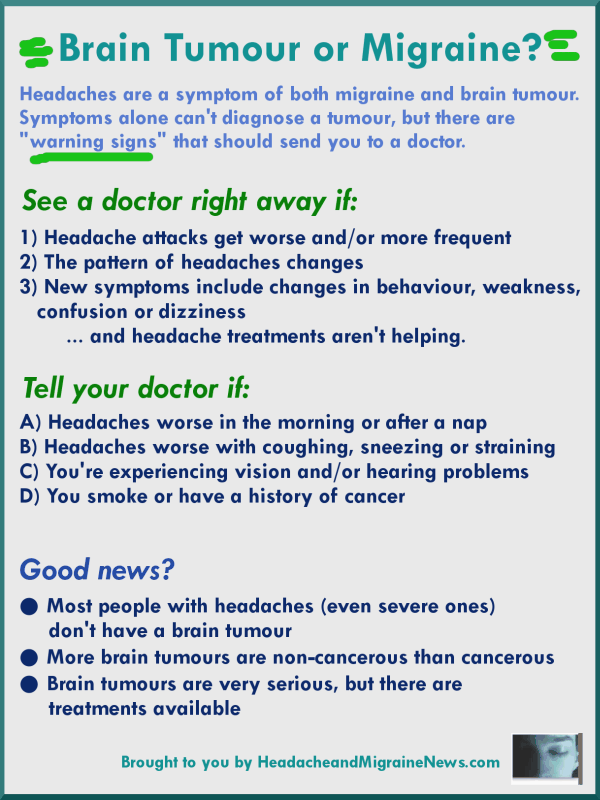
Also see: Brain Tumor or Migraine?

 If you’re experiencing headaches during or after chemotherapy, you probably don’t need to be told that your body is already going through a lot of unwelcome changes. There are a huge number of things that can lead to head pain – the chemotherapy itself, other medications (including “painkillers”!) that you take along with the chemo, the cancer itself, changes in schedule and eating habits, and the many other changes that are happening in your body that are directly or indirectly related to your treatment.
 For many years researchers have been asking the question – does an h. pylori infection lead to more migraine attacks? And if so, could treatment lead to a better quality of life for migraine patients?