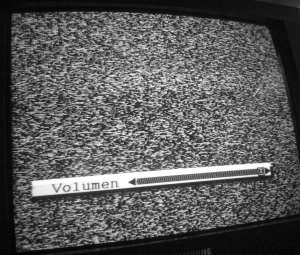
Visual snow is, of course, a visual symptom. We talk about it here because of its close relationship with migraine. Visual snow refers to what the patient sees – “snow” or “static” – in the case of persistent visual snow, it’s long term or even permanent.
Visual snow symptoms are often accompanied by migraine symptoms, and other issues as well, such as tinnitus, seeing flashes of light, and night blindness.
Visual snow illustration, courtesy KaidorRecently, Australian researchers took the time to do a review of the medical literature to see what they could learn about visual snow syndrome (VSS) and its relationship to various symptoms and other conditions.
Although they certainly recognized the relationship between VSS and migraine, the evidence seems to suggest that they are overlapping but different conditions. In their words:
Consideration of the individual symptoms suggests that multiple factors are potentially involved in the development of VSS, including subcortical network malfunction and cortical hyperexcitation. Although there is substantial overlap between VSS and migraine syndromes in terms of co-occurring symptoms, both neurophysiological and neuroimaging studies provide substantial evidence of separate abnormalities of processing, supporting these as separate syndromes. [source]
You can read a previous article comparing persistent migraine aura and visual snow here, although it should be noted that the researchers were talking not so much about a symptom of visual snow (which can have many causes), but of a specific syndrome.
The short story is that VSS probably has a complex origin – that is to say, more than one thing working together to cause it. Some of those things may also relate to migraine.
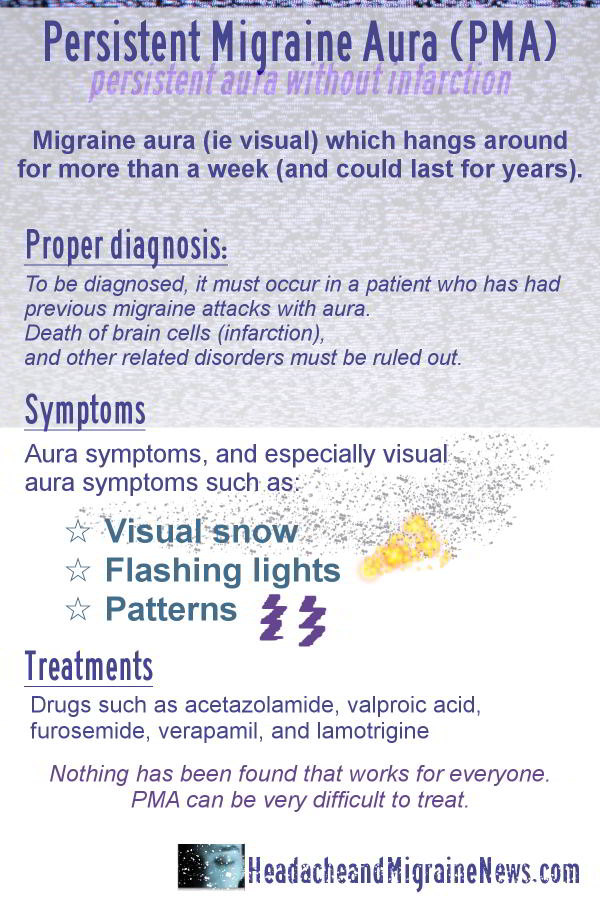
Migraine aura (ie visual) which hangs around for more than a week (and could last for years).
Proper diagnosis:
To be diagnosed, it must occur in a patient who has had previous migraine attacks with aura. Death of brain cells (infarction), and other related disorders must be ruled out.
Symptoms
Aura symptoms, and especially visual aura symptoms such as:
Visual snow
Flashing lights
Patterns
Treatments
Drugs such as acetazolamide, valproic acid, furosemide, verapamil, and lamotrigine
Nothing has been found that works for everyone. PMA can be very difficult to treat.
Visual Snow (VS) has (thankfully) been the topic of more and more conversation lately. Earlier this year, a presentation at the American Academy of Neurology Annual Meeting on visual snow was entitled Visual Snow: a New Disease Entity Distinct from Migraine Aura.
Sure, it’s different from migraine aura – but what is it?
Now researchers are trying to delve further into the mysteries of VS – exactly what is happening in the body that makes VS happen?
Leading the research is neurologist and headache specialist Dr. Peter J. Goadsby, director of the UCSF Headache Center. He is working along with Dr. Christoph Schankin, also at the UCSF.
I believe at the moment they are looking for people willing to do a phone interview. If you’re dealing with VS, please take the time to email the research team, and push forward our knowledge of this little understood (and little treated!) condition.
In the last post we introduced two concepts – visual snow (VS) and persistent migraine aura (PMA). The first is a specific symptom which can have a number of causes; the second a diagnosis which can include the first.
First, persistent migraine aura (PMA) is diagnosed when other causes are ruled out. But as we’ve said there are a number of things that can cause visual snow (VS).
Doctors will take a careful drug history for patients with VS, because one cause is hallucinogenic drugs. The drug may only have been taken once, and time may have passed since it was taken, but it can have permanent effects.
Optic neuritis, an inflammation of the optic nerve, can also be a cause. Optic neuritis usually develops from an autoimmune disorder. Read more about optic neuritis here.
There are many other things that can be involved – even vitamin deficiencies.
Dr. Klaus Podoll, Dr. Markus Dahlem and Sofia Greene list common tests that are done for persistent aura symptoms here. These include:
Ophthalmologic examination
Neurological examination
Psychiatric examination
Thorough headache history and family history
Thorough drug history (including illegal drugs, especially hallucinogens: LSD, Ecstasy, mushrooms, other?)
CAT or MRI of head (the MRI is important to rule out what is called a migrainous infarction)
Other examinations may follow, including an EEG, evoked potentials (a testing of the functioning of the nervous system), blood work, and a lumbar puncture.
Obviously, if anything shows up on these tests, you’ll be following that up.
Assuming these treatments are out of the way, there are some treatments that have been tried, with some success. There is no tried-and-true established treatment, but some options include:
valproic acid
acetazolamide
lamotrigine (particularly for VS not classified as PMA)
topiramate (Topamax)
Sometimes injections of furosemide (frusemide) are used, if other treatments fail. Clonazepam is also used for patients who have symptoms from hallucinogenic drugs.
Do you have experience with ongoing migraine aura, or visual snow? Have you found anything that has helped? How did the symptoms start?
We’ve talked a lot about migraine aura – especially visual aura – here in the past. Typically, visual aura hits before an attack of pain in migraine, although sometimes it hits all by itself, and can be quite debilitating in its own right.
But what if that visual aura never went away?
That’s what does happen to some people. I’ll get more specific in a moment, but first a couple of important notes…
Is this migraine?
There is some debate over whether these visual symptoms should come under the classification of migraine at all. Now of course, there are many things that can cause aura-like symptoms, shall we say. So of course those other issues need to be ruled out before you can even consider whether or not this is migraine-related.
Next, we have to ask if the visual symptoms are the same as migraine aura, or if they have unique properties. This could mean there is a different cause, though it still could be that there is a root cause involved in the migraine attacks and the visual symptoms.
Finally, even if the symptoms are the same, there is still debate over how closely they are related to migraine. Does the patient have individual migraine attacks? Could there be a common cause of both? Could it be a similar symptom from another cause? These are difficult questions to answer, though we certainly seem to be getting closer to answers as our understanding of the brain increases.
What is Persistent Migraine Aura and Visual Snow?
Last year I was corresponding with someone about persistent migraine aura, and visual snow, and they pointed me to some helpful information. I would give them credit, but for some reason I can’t find the correspondence at the moment (what? James isn’t perfectly organized? I’m so disillusioned!)! But I appreciate the nudge to post on this topic.
Persistent Migraine Aura (PMA), also known as persistent aura without infarction, is diagnosed when there are aura symptoms lasting more than a week without evidence of infarction (which refers to the death of brain cells). This is in a patient that already has migraine with aura, and then has symptoms that are typical of their migraine attacks but lasting longer.
Often these symptoms are only on one side, though not always. They can continue for weeks, even years.
Visual snow (VS) is a more specific symptom, which could be a part of PMA or not, or even a symptom that is a part of a totally different diagnosis.
As you might guess from the name, VS is when the person sees "snow", like static on an old TV, all the time. This may be a temporary condition, or pretty much permanent. VS is often accompanied by other symptoms, and other types of visual disturbances, as the video below illustrates:
What’s causing it?
That question doesn’t always have an answer. As mentioned above, often it’s related to migraine and considered a part of migraine disease.
Sometimes there are other causes – at least suspected causes. Research on VS is extremely limited, and though the visual symptoms do have some patterns and relate to other symptoms, it’s sometimes hard to know if there’s a solid related cause, or just two things that are comorbid (that tend to go together, though we may not know why), or if there’s just a coincidental relation.
In our next post on the topic, we’ll talk a little more about possible causes, and what treatments have been suggested.
For now, remember that this is a condition/symptom that is known by (some in) the medical community, and if you’re suffering from it you are by no means alone.