Over the past many years that I have written about headache disorders, every once in a while there’s something that helps a lot of people. Everyone is unique, of course, so often it’s the little things that help a few people here and there.
But I’m talking about things that have helped a wider number of people, just based on the unscientific feeback I get. 🙂 One of those things has been magnesium – a simple thing that has helped a lot of people. We’ve talked about it a lot.
But I’ve also received a lot of feedback on the work of Dr. Josh Turknett. Dr. Turknett is a neurologist who has studied migraine and diet extensively, and he has written two helpful books:
This is an introduction to his research on migraine, with lots of helpful tips. It explains his approach to migraine from the bottom up. If you want to understand more about migraine and learn how to take specific steps to fight it, I highly encourage you to start here.
Don’t be put off by the title – even if you’re not ready to go hard-core keto, this book helps you design a migraine-fighting diet that could make a huge difference in your life. And, of course, that’s my whole point – these books have helped a wide range of people fight migraine in practical ways.
The human body is incredibly complex. A full understanding of how it works and how it’s all balanced together is still far beyond the reach of modern science. And so there’s a lot to talk about.
Oxalates are natural chemicals in your body, and are also found in some foods, such as (you guessed it) spinach, almonds, peanuts, potatoes, chocolate, carrots and raspberries.
Oxalates have become a topic of conversation partly because of the popularity of the book Toxic Superfoods by Sally K. Norton. But the book has also been highly criticized as more health-hype than health-fact.
The fact of the matter is that oxalates have been a concern in the health field for more than a century. As early as 1933, migraine among other things was being connected with too much oxalate intake.
As with anything, there’s too much of a good thing. It’s not so much controversial that too many oxalates collecting in the body can cause problems (such as, most famously, kidney stones).
The controversy instead centres around just how common oxalate problems are, and just what kinds of health conditions they can cause. Some of the criticisms around Norton’s book, for example, are that she seems to associate almost every health condition and the fall of western civilization to eating too many oxalates.
I exaggerate, of course, and I think that some of these criticisms are a bit unfair as well. The fact is that our bodies are indeed complex, and doctors are often very hesitant to blame health issues on diet unless the connection is direct and obvious.
The nature of this controversy means that, if you’re interested in investigating it, you’ll need to do more than watch a couple of videos on YouTube. It will take some time to look at various sides of the issue, and to take a good look at what your body is telling you.
Norton is suggesting (among other things) that in many ways modern health crazes are pushing our bodies out of balance. To suddenly load up on spinach smoothies may indeed be too much of a good thing. And certain diets, in their effort to duplicate and feed our every craving, end up causing two problems as they solve one.
Even the question of which foods will cause problems with your oxalates can be complicated. But if you’re dealing with health issues and want to investigate diet solutions, I recommend looking into this question and making your own decision. Take a look at some of the foods commonly said to be high in oxalates. And do some serious reading of the research.
Norton’s book is one resource you can check out. But be warned that this is not a light, motivational self-help read. To understand her side of the issue, I strongly recommend you take the time needed to understand it. And she does address some of the concerns of her opponents – you can decide if her answers are helpful/satisfactory.
This issue raises some important general questions. Is it hopeless to try to improve our diets? Will the research of 2029 completely change diet recommendations for migraine and other similar conditions that we had in 2024? How can we make the best decisions now without being caught in fads that might not serve us well? Science is a moving target, and it should be, since it’s based on questioning and retesting. But we still want to make the best decisions we can by wisely interpreting the information we have today.
There are some rules that seem timeless, and moderation is one of them. And that may indeed be part of the issue with oxalates. But the human body is much more complex than a “just do this” diet can address. Your body changes as you get older. Rapid industrialization is changing the food that is available to us, meaning that the nutrients in common foods may not be what it was a hundred years ago. Migraine sufferers have specific needs that may not be addressed by “fad diets” anyway.
There are general rules that can be helpful. But in the world today, don’t expect a silver bullet that will solve all your health issues. It’s going to take some work. But we’re up for it!
There are a host of available apps available to remind you to take your meds. Every one of them has its pros and cons. But here are a few to consider…
First, I should note that although I use a ridiculous amount of apps on my phone, I hate to add another app that can do something that I can already do with an app I already own.
If you have an app for your to-do lists, or a calendar, or even a notebook app that allows reminders (such as Evernote), you can set it up to remind you to take your medications. Apple’s Health app also has a medication reminder feature.
Second, I should admit that I’m not fond of subscription apps. I know why they exist, it entirely makes sense as a business model, but I just don’t have the cash to keep doling out more each month. But more power to you if you find the perfect subscription app.
For example, for years I used Medisafe Pill Reminder, and it’s excellent. I recommend it. But when it went to a subscription model, I began looking elsewhere.
There are also specific migraine trackers, that can track the medication you take, and even remind you to take preventatives. N1-Headache is one of these – an excellent app that especially excels in finding your true triggers. We’ve talked about it before – also highly recommended.
If, however, you want something more focused on medications, here are a couple of suggestions. I should also add that I’ve used apps like these for family medications. If you want to keep track of a parent’s meds or a child’s or whatever, this is the way to go.
MyTherapy Medication Reminder is a highly customizable medication reminder. You can add personal notes, get reminders when you need refills, “game-ify” your treatment by earning rewards, and even track symptoms and general health information. Also, you can easily export information for your doctor.
This much ability to add information and customize means that you could actually track things like headache level, giving you a lighter-weight way to track all meds but also specifically some headache info.
But the app that I’ve settled on at this point in my life is Pill Reminder – All in One. This is an extremely flexible app in which you can add multiple users, multiple medications (including abortive “as needed” meds – perfect for migraine), unique sounds for your alerts (which I really like), and easy-to-read views. It also has many of the additional features I mentioned for the previous app, such as exporting information for your doctor.
This one has a very small one-time cost if you want to add more than two alerts.
And here’s another bonus – no data is collected at all from this app. Privacy is a priority.
There’s no reason why you can’t download a couple of these and try them out to see what works best for you.
If you’ve found something else you love, leave a comment!
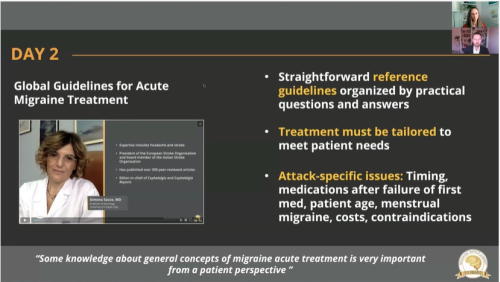
You can still watch the Migraine World Summit recap for free! I’m not sure how long the extended version will be available, but it’s right here.
The summit also announced that there is an extended discount if you would like to own the full 2025 library of migraine-fighting information. The discount is available until the 6th of April, and can be accessed right here: Access Passes
Funds raised through the access passes will be used to further cutting-edge migraine research and advocacy.
It’s almost time for the Migraine World Summit! Now that the summit is an established part of the fight against migraine, some people may wonder why we keep coming back.
This brief video is worth showing to your family and friends to give them an idea why the summit is so valuable. Check it out, and share! Remember, you can register for free right here. This year’s summit is the 20th – 27th of March.
… By the way, do you want to learn more about those 10 year impact statistics and where they come from? Click here for more…