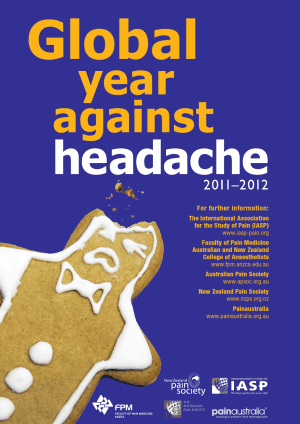
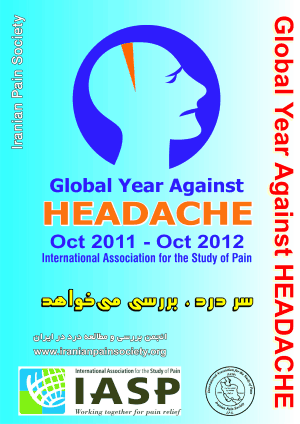
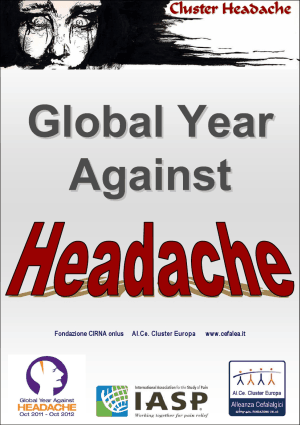
This month The International Association for the Study of Pain (IASP) wrapped up it’s Global Year Against Headache campaign.
Every year the IASP focuses on one type of pain in order to encourage discussion and research. A number of countries took part this year, including Australia, Canada, Iran, New Zealand, and the United Kingdom.
Below are some of the posters that were created to raise awareness. Thanks to the IASP and so many other people and organizations around the world for raising awareness!
A few weeks ago I asked on Facebook and Twitter for your suggestions for those who are thinking about going gluten-free. Here are some of the suggestions you gave, with a few I’ve received from other sources:
Websites
Crazy Gluten Free Lady: I’m certainly going to keep an eye on this blog. The brand new blog from Samantha (her friends call her Sam) is collecting recipes and tips for someone who is not only gluten free but a migraineur. Elana’s Pantry: After her son and herself were diagnosed with celiac disease, Elana went not only gluten-free but grain-free. Her recipes are interspersed with practical tips and real-life stories. Gluten Free Girl and the Chef: Shauna is the gluten free girl, and Danny is the chef. Again, a great variety of resources here. the-gluten-free-chef.com: Carol also has coeliac disease (yes, there are two spellings). This easy-to-navigate site will get you started with quick, accessible information. The Celiac Diva: Lauren-Lucille is the Diva who runs this fun, colourful site which goes far beyond "don’t eat gluten". Lots of resources, videos, and answers to your questions. Udi’s Gluten Free: Udi’s is actually a company in the USA. Their online store features many quality gluten free foods. Real Sustenance: Brittany focuses on recipes that are gluten and dairy free. Great recipes and inspiring photos. Gluten Freely: Another online store in the US from General Mills, Inc. Again, only available in the United States. Easy to use, lots of gluten free products. Trader Joe’s: If you’re in the US and you like Trader Joe’s, you’ll appreciate this gluten free guide.
Actually, I’m not going to list every comment – check out our Facebook page for more. But I have to say the best advice came from Sarah Grizzard: Focus on what you can have instead of what you can’t.
Seriously, there’s so much great food out there. Just because your family and friends may be wheat-a-holics doesn’t mean you have to be. And if you try to go gluten free, you can be sure someone will say,"Oh no, that means you can’t eat __________!"
Let’s face it, even the picture on this post focuses on the negative (I’ll try not to do it again!).
Many people mentioned – keep it simple, stick to unprocessed, fresh foods – yes, that includes fruit and vegies.
Do you have resources and tips you would like to share? Now you have another chance! Leave a comment. 🙂
I love my buckwheat pillow. The most recent one I bought was from Buckwheat Pillow Canada. I even went out on a limb and bought their small travel neck pillow, and it’s fantastic!
Buckwheat Pillow Canada is having a special shipping sale in Canada until the end of this month, so I wanted to share this video from the Ottawa Citizen. I’ve used buckwheat pillows for years, but even I learned something!
Many migraineurs in the USA have expressed the desire to have a patient operated organization focusing on headache and migraine. Well – good news! The dream is becoming a reality!
The American Headache and Migraine Association (AHMA) has been created with the help of the American Headache Society (AHS) as a result of a vote on June 21st. The new organization will have a 10 member board, with 5 patients and 5 AHS members. Long time migraineur advocate and health writer Teri Robert will chair the board, and Dr. Paul Winner, chair of the ACHE (the American Headache Society Committee on Headache Education), will co-chair. It will be a part of ACHE.
This organization is all about patients connecting. More information will be coming soon, but in the meantime we know that a website is going to be up soon, and that you’ll be able to join at a very modest fee ($15 per year), and that the first conference is already planned!
That’s right – write it in red on your calendar (or perhaps a more migraineur-friendly color) – November the 17th 2013 in Scottsdale, Arizona! This is actually at the end of the AHS Scottsdale Symposium, which means some of the country’s top specialists will be available to interact with – you!
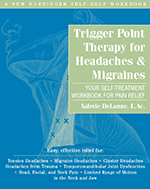
Great news! Valerie DeLaune, author of Trigger Point Therapy for Headaches and Migraines, will be offering a free webinar on Tuesday, the 10th of July 2012. The topic is "Understanding Trigger Points".
We’ve talked about trigger points here before (see Trigger Points and headache – Fakery or Fact?. I’ve promised to talk about them some more – but it’s been 4 years, and some of you are losing hope!
So while you’re waiting, take in this great seminar and learn more about trigger points and how they impact your overall health.
If you’re a massage therapist or a another type of hands-on health professional, you’ll especially appreciate this seminar, which will help you better understand how to help your patients.
Here’s the official description of the event:
About 75% of the time, pain is caused by trigger points. Pain syndromes cannot be treated effectively without identifying and treating trigger points, since about 74% of trigger points are remote to where your patient feels symptoms. Trigger points usually refer pain in fairly consistent patterns, and you can use "pain guides" to figure out which muscles may potentially harbor trigger points causing pain and other symptoms.
Trigger points are caused and perpetuated by poor ergonomics, injuries, structural problems, and several medical conditions. Resolution of these perpetuating factors is crucial to relieving trigger points. Tips will be given for incorporating trigger point treatments into existing practices.



 (
( ): Brought to you by Elana Amsterdam (yes, from Elana’s Pantry above), this inexpensive paperback features recipes that are "low glycemic, low in cholesterol and dairy, and high in protein and fiber".
 (
( ) (
) ( ): Brought to you by Elisabeth Hasselbeck. If you’re in the USA, you may have seen her on TV. Elisabeth has created a highly rated, full-colour cookbook that so far gluten-freers are loving.
 (
( ) (
) ( ): From the blog of the same name, this book combines 100 tested recipes from a professional with a love story.
 (
( ) (
) ( ): I’ve been reading through this updated guide to being gluten-free. Lot’s of helpful information in a clear and fun format. The Kindle pocket edition is currently only $2.99!
 (
( ) (
) ( ): For those who can’t do without bread and cookies, this 2011 recipe book contains 150 recipes.
 (
( ) (
) ( ) and
) and  (
( ) (
) ( ) from Iris Higgins and Brittany Angell (from Real Sustenance above). Gluten and allergen free baking, learn the basics of baking without eggs, corn, soy, and dairy. One look at the covers of these books, and you’ll know they’re pulling out all the stops.
 (
( ): With a title like that, who needs a description? 🙂 I admit I almost didn’t buy this book because of the cover. Is this a book for people who are gluten free but want to live on brownies? But actually, the book is very practical, loaded with helpful information, and especially useful for those in the USA, Canada, and the UK (because of the information about laws and labelling).
 .
.