So many people have said that their migraine attacks became worse over the past year. Well, now it’s time to fight back, and take some time for ourselves to find new solutions.
The dates for the 2021 Migraine World Summit have finally been announced. The free online event is scheduled for the 17th-25th of March, with special live events that will be explained soon.
I’ve already had the chance to hear from one of the event’s co-hosts, Carl Cincinnato, and I can tell you that there are some exciting innovations in this year’s summit.
For one, this is the first summit that will really be able to take into consideration new realities in the world that are affecting our migraine symptoms. You will be able to hear from experts who have been involved in migraine treatment over the past year, and who have new insights.
There is also at least one major topic that has never been covered in detail at the summit in past years – I’ll tell you more about that later!
I always encourage people to register ASAP, even if they’re not sure if they will be able to attend (remember, it’s online – still, we’re busy, and often don’t want more screen time on a given day!). Why? Because the number of people registered shows experts, researchers, advocates and policy makers worldwide just how important fighting migraine really is.
So we’ll announce more details later, and you can decide how you want to be involved in March when the time comes. But today – it’s easy! – just take a couple of minutes to register for free on the Migraine World Summit official site. Let’s show the world that ending migraine pain is a major priority.
Congratulations to our HeadWay subscriber – Sally Anne, from the USA – who won a copy of…
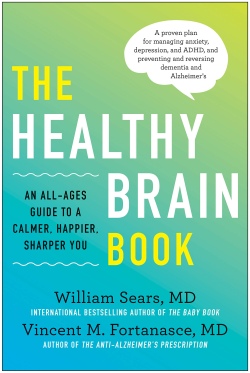
The Healthy Brain Book: An All-Ages Guide to a Calmer, Happier, Sharper You: A proven plan for managing anxiety, depression, and ADHD, and preventing and reversing dementia and Alzheimer’s
Don’t you love books with short, catchy titles? 😀 Of course, the book has two authors Drs. William Sears and Vincent M. Fortanasce), so I guess that’s a good reason for an extra long title.
Anyway, this book is packed with tips for a healthier brain.
If you’re not a HeadWay subscriber, you can sign up right here for free. Not only can you be involved in giveaways like this, you will also have a special say about the topics we focus on, through your input in the HeadWay MailRoom.
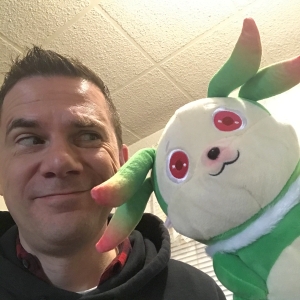
And, of course, I’ll explain who my little “friend” is.
A quick search on Amazon for children’s books about migraine will convince anyone that there was a gap to be filled. Material about migraine especially for kids is rarer than it should be.
Enter Ryan Williams. Someone with the title of Marketing Director at StudyKIK would seem like an unlikely candidate for a children’s book author, but this actually isn’t his first book.
It will help to know that Ryan actually helps to connect patients to clinical trials, and so has a lot of contact with patients with all kinds of struggles. And so he has successfully Kickstarted books on Alzheimer’s Disease and Crohn’s Disease, as well as migraine.
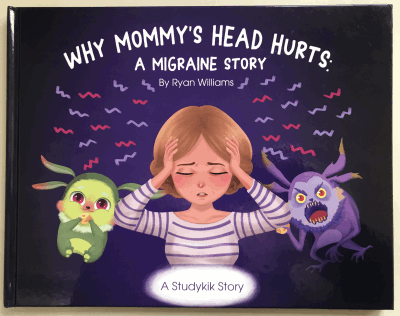
So let’s get into the book! It’s a high quality large hardback, glossy, lots of colour – so far so good for young children!
And looking at the cover below, you’ll see two creatures – a cuddly fuzzy green one, and a nasty toothy red-eyed purple one.
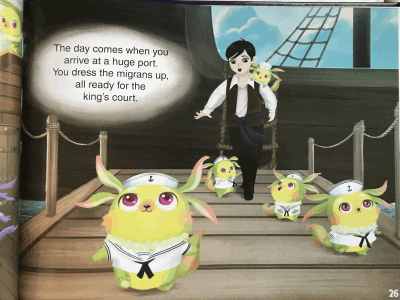
So without giving away the whole story, here’s what happens. A young adventurer sails to a mysterious island, and adopts several mysterious creatures, which he calls migrans.
But early on, he discovers that these creatures can be “irritated” in various ways, turning them into the scary purple monsters. And so he finds ways to keep them green and cuddly.
By now you’ve probably guessed that the green creatures represent a happy, healthy head. The purple ones represent a head in the midst of a migraine attack. And so the book the children about triggers and simple ways to calm the migraine beast.
You might guess what the challenge of the author is here. First, not everyone shares the same “triggers”. Migraine attacks, even for a single person, may get started because of one thing one day, and one thing another day.
The other challenge is that the focus on triggers means that there’s no time to talk about some of the wider issues, such as preventative treatments and lifestyle changes.
But, after all, this is a children’s book with a single purpose. Let’s not make things too complicated.
Let’s put it this way. This book is not a medical treaties. Neither is it a replacement for a talk between an adult and a child. It’s a conversation starter. It’s a way to start talking about migraine. And a way for young kids to learn how they might even be able to help Mom or Dad when the migraine monster hits.
After all, it’s easy enough for the parent or adult friend to say, “It’s different for me. For me, this would be more helpful.” Or, “Sometimes this food doesn’t bother me.”
And so I give this book a thumbs up for opening the door to what sometimes might be a difficult conversation. It’s colourful, fun, and would look great in a doctor’s office or on your own coffee table.
Ryan kindly sent me this book to review, and also sent me the actual migran shown in the picture. Which so far, thanks to careful care, has remained his green, squishy self.* Or – is it a girl? How do you tell with migrans? Never mind, I don’t need to know.
Anyway, you might be able to catch a copy of Why Mommy’s Head Hurts on Amazon (and by the way, this is not a “board book” as the listing currently says. It’s a hardcover). But to get the full-meal-deal with the cute migran and all, go to Etsy.
* No, the stuffed creature actually does not change colour or become a monster, no matter what you do to it. It stays just the way it is in the picture. I just like to pretend. 😀
Would you like to sit back and pop a YouTube video up on the TV so you can learn or relearn some of the basics of migraine?
Well, Dr. Josh Turknett, author of The Migraine Miracle and Keto for Migraine has taken the time to share the first in a series of videos designed to get you up to date. With lists and charts and diagrams, you’ll get to know a little more about “The Beast” of migraine. It’s not your typical 3 minute summary, either, so get a healthy snack and grab a pen and paper to take notes.
And you don’t even have to go elsewhere, I’ll share the first video (the only one available as I write this) below. Enjoy, and let us know what you think!
Oh – almost forgot – once you watch the video, you can take a quiz to see how much you remember! Check out the quiz here.
I have a tennis ball and a racquetball in a drawer in my bedroom. Why? Because they’re handy, inexpensive self-massage tools.
I was recently looking at an article on massage, and saw this quote:
My orthopedic surgeon didn’t know about using tennis balls for massage! He asked what helped my back pain, and I told him I always lie on a tennis ball. He looked at me like he was going to refer me to a psychiatrist! How can an orthopedic surgeon not know about the tennis ball thing? Doesn’t everyone know about the tennis ball thing?
Well, yes, exactly! There are some great massages that you can do with a tennis ball, and you can get a pack of three for under $10. A raquetball is a little smaller and harder (and even cheaper). A lot of people also recommend lacrosse balls, which are almost as big (sometimes as big) as a tennis ball, but they have a nice rubbery texture, perfect for massage (and they come in lots of fun colours). (I have to support lacrosse – it’s the official summer game of Canada, did you know that?)
And, of course, there are balls made especially for massage such as the TriggerPoint Foam Massage Ball for Deep-Tissue Massage, which has gazillions of high ratings. You can choose the size and firmness of these, which is handy. But again, if you already have a tennis ball around the house, try that first and see how it works for you. Save your money and give it to the Migraine Research Foundation instead.
Massage is a very personal thing, so I won’t share the “ultimate headache massage” here, although we would love to hear your comments about what has worked for you. And massage for headache isn’t just head massage – and not just shoulders. Even a foot massage (grab the racquetball for this one) can help with headache.
Now I’ll let you go, because you’re going to want to check all that out, and hunt down the tennis ball from the garage. Hmmm… might want to wash it first…