Our latest poll asked the question: Which of these (ie medications, supplements, other treatments) have been the biggest help to you?
At first the results may sound like a big yawn – predictably, medication was the runaway winner. So, it seems, more people have found help through medication than through anything else.
But wait – the news is both better and worse for medications. First, you can see right away that either medications, or medications combined with something else, were the runaway winners. 86% included medication as something that has helped.
But another interesting point – most people were not helped by medication alone. Let’s look at the chart that way:
So in actual fact, most people were helped by medication plus something else, or else by something other than medication.
Of those, the biggest chunk were helped by medications + supplements + another treatment!
Let’s look at this one more way. What percentage of people found either supplements, medications, or other treatments, to be helpful? Here’s what the results look like:
It’s tempting to say,"Oh, medications help the most people – I’ll focus on those!" But here’s the thing – there really is no clear winner here. If anything, the winner is variety. For example, let’s see how it looks if we do combinations vs single treatment:
Now you could argue that certain things may skew the results. After all, the millions of dollars of promotion in the medical wold goes to the medications. Then again, supplements (like magnesium, probiotics) and other treatments (like acupuncture, biofeedback) have a huge popular following.
But when push comes to shove, it’s clear that there is no one thing that works for everyone when it comes to migraine and chronic headache. It’s often medication, but not always. It’s often one thing, but often a combination (I would argue that it has to be a combination, if you’re working toward total health).
When we talk about the hundreds of treatments for migraine (for example), we’re not just talking about drugs (though there are a lot of those!) or supplements (lots of those too, well researched and effective) or other treatments (lots of those, including lifestyle changes). We’re also talking about combinations.
That’s why you can never try every possible treatment in your lifetime. And I’m not talking about quack treatments – I’m talking about well researched treatments that are helping real people.
Of course there are a lot of issues wrapped up in that – how to chose good treatments and not waste time and money on bad ones, how to safely combine treatments, and so on. But when all is said and done, that is the state of headache and migraine treatment, and this poll reflects it. There’s no silver bullet – but there are good treatments. Don’t give up!
Here are the full results:
Medications alone: 44% Meds, supplements and other treatments combined: 21% Meds and Supplements combined: 11% Other treatments with meds: 10% Other treatments alone: 9% Supplements alone: 4% Other treatments with supplements: 1%
Menstrual migraine (including menstrually related migraine, true menstrual migraine, etc, and sometimes called a period headache) certainly isn’t the only type of migraine out there. But it is a common type. And it is… well, different!
Until recently, menstrual migraine often wasn’t distinguished in diagnosis and research from other types of migraine. But now we’re starting to study it as something unique, and because of that we’re learning more about it than ever before. Some recent studies are shedding more light on the uniqueness of menstrual migraine. For example, did you know:
Menstrual migraine attacks tend to last longer than other migraine attacks. A recent study suggests that they last more than 30% longer, on average, than other migraine attacks. (Pinkerman and Holroyd 2010)
Menstrual migraine responds better to certain treatments. More on that below.
Menstrual migraine doesn’t respond as well to short term treatment, such as abortive drugs. Often preventative treatment is the answer (menstrually related migraine may happen at various times of the month, in an unpredictable pattern). (Pinkerman and Holroyd 2010)
Menstrual migraine is more likely to be disabling. Of course, other types of migraine may disable more, but on average menstrual migraine seems to often be worse than average. (Pinkerman and Holroyd 2010)
Menstrual migraine is more likely to return. A recent study demonstrated that the pain was far more likely to come back after four hours being pain-free. (Pinkerman and Holroyd 2010)
Menstrual migraine may have distinct biological differences, beyond "hormones". Recent research is looking into the various factors that may cause menstrually related migraine, including genetics. (Colson et al 2010, Aurora 2008 in Menstrual Migraine)
Monthly attacks are more likely to be migraine without aura or tension type headache. Migraine with aura is less likely to be linked to your period. (Stewart et al. 2000)
Menstrually related migraine affects up to 60% of female migraineurs (Lay and Payne 2007)
Treatment!
Menstrual migraine may be severe and hard to treat, but it has been treated successfully in many, many women. However, doctors are realizing more and more how important it is to get a proper diagnosis, and to treat menstrual migraine specifically, not just the same way any type of migraine is treated.
Although this type of migraine may not respond as well to short term treatments, some women find that an abortive drug is all they need. Usually this is a triptan (commonly sumatriptan, rizatriptan or frovatriptan), and/or NSAIDs such as mefenamic acid or naproxen. Sometimes something is given for the nausea as well. Dihydroergotamine (DHE) is also an option.
If one triptan doesn’t work, try another. There are several others that have helped many with menstrual migraine.
On the preventative front, one common approach is hormone therapy. Magnesium therapy also seems to be particularly effective for menstrual migraine. There is some evidence that vitamin E may help with some symptoms.
Preventative medication may also be tried. Typical migraine preventatives have met with some success, such as verapamil (a calcium channel blocker), topiramate (particularly for patients who don’t take oral contraceptives) and valproate, propranolol (a beta blocker), and fluoxetine (an anti-depressant).
Yesterday the FDA in the United States officially approved Botox for use with chronic migraine patients. This follows a similar approval in Britain for Botox this past summer.
This is a continuation of an up-and-down roller-coaster ride for the controversial treatment. Read more in the New York Times article: Botox Shots Approved for Migraine.
To treat chronic migraines, Botox is given approximately every 12 weeks as multiple injections around the head and neck to try to dull future headache symptoms. Botox has not been shown to work for the treatment of migraine headaches that occur 14 days or less per month, or for other forms of headache. It is important that patients discuss with their physician whether Botox is appropriate for them.
The most common adverse reactions reported by patients being treated for chronic migraine were neck pain and headache.
OnabotulinumtoxinA, marketed as Botox and Botox Cosmetic, has a boxed warning that says the effects of the botulinum toxin may spread from the area of injection to other areas of the body, causing symptoms similar to those of botulism. Those symptoms include swallowing and breathing difficulties that can be life-threatening. There has not been a confirmed serious case of spread of toxin effect when Botox has been used at the recommended dose to treat chronic migraine, severe underarm sweating, blepharospasm, or strabismus, or when Botox Cosmetic has been used at the recommended dose to improve frown lines.
Side effects have been rare with Botox treatment, but you are wise to find someone experienced giving Botox injections for migraine, referred by a doctor who knows your medical history.
Before we get into the review, let me give you a summary: what the SootheAway Continuous Thermal Therapy Device does, it does very well. Better than anything else I’ve seen.
No, that doesn’t mean it’s perfect. But let’s take a close look at it – step by step – and you can draw your own conclusions.
The SootheAway Continuous Thermal Therapy Device (from here on in we’ll call it the SootheAway CTT Device) comes from a company called Innovative Medical Equipment, founded by Dr. Bahman Guyuron. Dr. Guyuron has specialized in various types of surgery in the USA and Canada for many years, most significantly plastic surgery and maxillofacial surgery, as well as surgery for migraine. It’s appropriate that his company has created a natural treatment that can both help with pain from surgery, and perhaps even help patients avoid surgery.
What’s the Point?
So what is the point of this device anyway? The SootheAway CTT Device is designed to fight pain by providing constant heating or cooling. I know what you’re thinking – give me a heating pad, an ice pack, or an old sock filled with rice! Why would I want a machine when something simple can do the job?
There’s a very good reason why you might want this device. Think about it – what’s the problem with some of those other heat/cool solutions you mentioned?
Well, first you have to heat/cool them. Then you have to use them quick while they’re still hot/cold. Either they start too hot or too cold, or they cool/warm too fast. Then you’ve got all that condensation on the ice pack. Sometimes it won’t conform to the part of your body you need it for. And before you know it you have to stick it back in the freezer or microwave.
The SootheAway CTT Device provides – again – a constant temperature. Let’s see exactly how it works and you’ll see what I mean.
Setting up the SootheAway CTT Device
I’m going to go all through the use of the SootheAway CTT Device so that you know exactly what to expect.
Setup is very easy. However, if possibly I suggest you set it up ahead of time, before you have a blinding migraine attack. Have it all set up and handy, so that you can use it right away when you’re in pain.
That being said, I decided to wait until I did have a migraine attack. And it was still easy to set up.
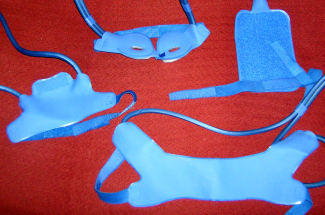
The SootheAway CTT Device comes with one or more "pads". Each of these focuses on one or more areas of the body. I used different ones at various times, because I commonly have pain in more than one area.
There’s a universal relief pad (excellent for joints, back, stomach, etc) (this is the rectangular one to the left), an injection relief pad (meant mainly for physicians to use before treatments such as Botox injections), and coming soon a shoulder/knee pad.
But there are three other pads that you’re more likely to use for headache or migraine pain. First, a front and side head relief pad, covering of course your forehead and down the sides. This one is not only good for headache pain, but also jaw/TMD/TMJ pain. Next, the back of head (occipital region).
Finally, the eye and sinus pad (padded), that goes over the eyes. You may find one or all of these is useful during a headache or migraine attack.
Now, let’s set it up…
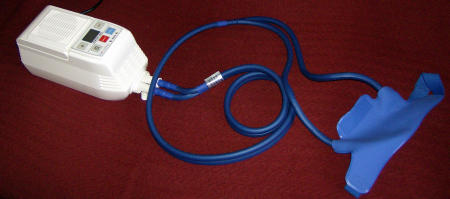
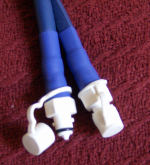
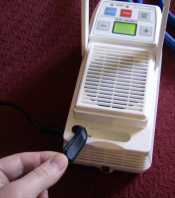
You take one pad and connect it (push and twist) to the main SootheAway CTT Device.
Add water here
Next, you put some distilled water into the reservoir (an extremely small amount. One bottle of distilled water may be all you’ll need for months/years). There’s a min/max indicator to guide you.
That’s it! Your device is all set up. Now, let’s use it.
Using the SootheAway CTT Device
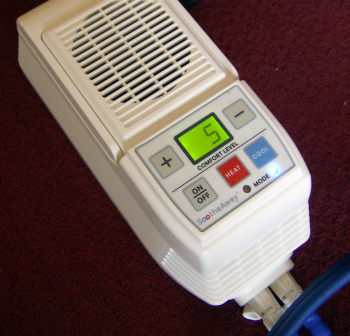
I like devices that are simple to use. This one is very simple. First, push ON/OFF to turn it on. Now, choose whether you want heat or cool (by pressing either "HEAT" or "COOL". See what I mean?).
Now you can choose the level of heat or cool you want (by pressing + or -).
You choose a temperature between 1 and 10 – 10 being the coolest/hottest, 1 being just slightly cool/hot.
You may want to wait 10 minutes for the temperature to stabilize, but once you’re used to the device you’ll find that it begins to be warm/cool right away, so most often I put the pad on immediately.
So, once you’ve set the temperature, you put the pad on your head (or wherever the pain is) and adjust it using the Velcro straps (note – these pads will also provide gentle pressure – as much or as little as you want, while keeping your hands free. This alone is a huge benefit). Then – relax!
How (well) does it work?
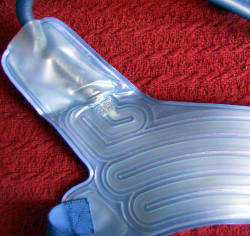
As I said at the beginning, for what it’s intended to do, it does it well – very well. How does it work? Well, the distilled water is circulated through small tubes in the pads (see left). That way, the pad stays at a constant temperature.
If you’ve tried heating pads, ice packs, and so on, you’ll find that this is all the benefits with none of the problems. The temperature does stay constant – you don’t need to move it around, turn it over, refreeze it or wipe it off. It just keeps steadily cool.
That means that it provides much better pain relief than an ice pack. In fact, it’s amazing.
More pros and cons
But you said it wasn’t perfect – what’s the problem?
Well, let’s look at some of the pros and cons, as I see them.
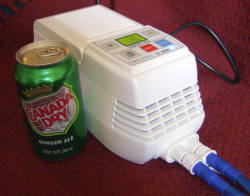
Cons: It’s big. You do have to put it somewhere. All right, not huge, but when you have those tubes, a pad or two, and the main machine, you can’t just stick it in your bedside table.
Secondly, it makes noise. Not much – and it’s just a hum. Now it’s just white noise, which some people with migraine like anyway (since it blocks out other noises and can help you sleep). The noise wasn’t enough to bother me, but it’s there.
Also, the lights on it are very bright – why? Just put some electrical tape over those hot and cold lights, and you’re ok. (Now you know I really had a migraine when I tried it – and I tried it a few times) 🙂
The price will be a problem for some. The SootheAway CTT Device is now selling for US$299 (with one pad). You’ll have to think about whether or not you have pain often enough to invest. Hopefully I’m helping you make an informed decision.
Also, to be fair, the device has a 30 day money back guarantee, which means you can try it without risking the money.
Finally, the company does recommend you take it off after 30 minutes, and wait 10-15 minutes before putting it on again. Actually, I’m not even sure this is a con. It worked so well that a 10-15 minute break wasn’t a problem for me. Just want to let you know all the details.
Pros: One thing I was concerned about was how these tubes would interfere with movement/sleep/etc. But they’re solidly attached and well built. I tried working while using a pad, and resting/lying down, and sitting up – no problem. Everything is long enough to give you space to move, and nothing is going to come undone.
Very easy to use. And easy to adjust. Some people like alternating heat/cold… no problem. If it’s not cool enough, or becomes too cool, no problem. The temperature is very easy to adjust slightly.
Various pads for various types of pain. In fact, during the time I was testing the SootheAway CTT device, my doctor prescribed some heat treatment for something other than headache. Even though I didn’t have a pad exactly the right size or shape, I turned one up-side down and it worked just fine. It’s very very versatile.
But the ultimate pro of the SootheAway CTT Device is the reason it was created – it provides a consistent, constant cooling or heating to fight pain. If you have something else that works as well, let me see it. Otherwise, I have to give the SootheAway Continuous Thermal Therapy Device the gold medal!
Is it for Me?
Admittedly, if you’ve only have muscle, joint or head pain once or twice in your life, you may be reluctant to invest in such a professional unit. However, if you’re dealing with pain more often, and you’ve found that heat/cold therapy is a help, you’ll probably find that the SootheAway CTT Device will work ten times better than anything you’ve used before, with less hassle. This may mean that it’s not equally useful for all your attacks – some will respond better than others.
Though it’s not for everyone, if you do deal with migraine pain, muscle inflammation, joint pain, and so on, it’s worth serious investigation (which is why I’ve taken the time to give a detailed review!). The SootheAway CTT Device provides a lot of relief with no drugs, and no continuous cost (remember, drugs and massages and treatments usually involve an ongoing investment – this device is a one-time investment).
For me, I found that the SootheAway CTT Device was easy to use, and really did provide a lot of relief – relief that even continued after I had stopped using it. I’m happy to see natural therapy devices like this that really work, and work well.
Have you tried the SootheAway CTT Device? Leave a comment and share your experiences!
Readers of HeadWay will already be familiar with this one, but I thought it was about time to introduce it to all our 1% Thursday readers!
The Personal Migraine Fighter Plan (PMFP) is a way to gently improve your diet and fight migraine. It’s a way to personalize your diet, and introduce more good foods while eliminating more bad foods. But instead of using a rigid, blanket diet that’s supposed to work for everyone, it’s customized and flexible.
Every Thursday at Headache and Migraine News (weather permitting) we’ll talk about one measurable, practical thing we can do to make our lives just 1% better. Usually it will be something very easy, sometimes it will be a challenge. Let us know if you try it, or share an idea of your own – and maybe a year from now we’ll see that things have really changed for the better!