Migraineurs are dealing with a lot more than just head pain, according to a poll we recently conducted here at Headache and Migraine News. The pain of migraine comes in many forms – and sometimes pain comes from the migraine attack, while at other times a problem in another part of the body can trigger a migraine attack.
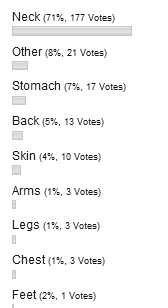
In this case, however, we were talking about pain during a migraine attack. Visitors were asked Other than your head, where do you experience the most pain (during a headache/migraine attack)?
It’s no surprise that neck pain and migraine pain are closely related. A full 71% of migraineurs said that they experienced neck pain during migraine.
Following that was other, with 8%, starting a list of other parts of the body where people experience pain.
Stomach is next on the list – very common (some people experience stomach pain instead of headache during a migraine attack – see more on abdominal migraine).
Back was next, and then skin (perhaps referring to cutaneous allodynia), and finally arms, legs, chest and feet.
In this poll, visitors were only allowed to choose 1 answer. But now it’s time to find out all the other kinds of pain that migraineurs experience. The new poll is similar – except that you can choose multiple answers. I’ve also added more possible responses: Other than your head, where else do you sometimes/always experience pain during a migraine attack?Add your votes now!
Last month I was in Calgary, Canada, and I was glad to see the Calgary Herald giving attention to chronic pain conditions. Although more attention could have been given to migraine and headache disorders (I’m not biased or anything), I appreciated the fact that pain was recognized as a major challenge.
Here are some quotes from the first article in the series. To read the whole article, click the link below.
One in five Canadians – roughly six million people – is living with chronic pain of some kind, sometimes as a result of trauma or illness, and sometimes for no obvious reason at all.
Doctors who treat patients living in pain say that any wait for care beyond six months is medically unacceptable, because early intervention can keep lives from turning into train wrecks. Uncontrolled pain can cost people their jobs, careers, homes, marriages, friends and sense of identity. People, including young mothers – and the burden of pain is greater for women than for men -lose the ability to take care of their families. Constant severe pain deadens personalities. Looking in the mirror, Heshusius said she sometimes hardly recognizes herself. "Who is she?" she wonders.
Pain is demoralizing and isolating. It can destroy people financially. People unable to work lose their benefits; they lose fights with insurance companies and workers’ compensation.
The instinct is to retreat, to curl up and wait for the torment to stop. People living with chronic pain are twice as likely to suffer major depression as people living without pain.
Does this sound familiar?
Experts blame the meagre training health professionals receive on assessing and managing pain (a survey of 10 major Canadian universities found that veterinary medicine students receive, on average, 87 hours of mandatory training in pain, versus 16 hours, on average, for medical students); inadequate funding for research (just one-quarter of one per cent cent of all federal dollars for health research in Canada go to pain); a health system that doesn’t compensate doctors for the time it takes to provide meaningful pain care ("we take up too much time," pain patients say over and over again), stigmatization and attitudes toward people with pain and a strong reluctance to prescribe opioids for chronic non-cancer pain.
So patients struggle to find doctors to help them, leaving the burden of care to fall on over-stretched pain clinics and the small number of community doctors willing to help. People with pain describe being treated like street addicts when they land in emergency rooms in a pain attack so severe they can barely put one foot in front of the other.
Lous Heshusius says what’s needed is a sea change in society’s mindset about pain.
"There is so much in society that works against pain relief, against us getting help – structural problems, political problems, funding problems."
We live in a society that says only that which can be seen and measured is true and valid and real, she says, "and I think that is doing us in."
She says she can’t count the times she has heard, "But you look fine." Or, "Can’t you take some pain pills for that? People have no idea what kind of lives we live."
Read the full article: Canadians living with agony of chronic pain (sorry! The article is no longer available.)
A surprising new study in the journal Pain turns up an unexpected and simple way to predict which patients will respond to treatment.
It’s always a mystery why some patients respond well to a certain treatment, while others do not. The bottom line at the moment is that migraine is a complex disease, and every patient is very different (yes, we’re complex too!).
This study evaluated patients who were somewhat or very disabled due to a headache disorder. The researchers studied a variety of factors to find out why some patients improved a lot and others not-so-much.
Was it social support? Type of headache? Race?
Nope. The one thing that made the difference – that predicted whether or not someone would improve – was simply whether or not they actually attended the three follow-up appointments.
That’s right. Patients who didn’t go to their follow-up appointments didn’t tend to improve as much. That’s it.
So please, don’t go to a "bare minimum" of appointments. Follow things through. Listen to your doctor. You may be surprised what a difference it makes.
This one has been spinning around the internet lately, so you may have heard it. It’s surely one of the most unusual painkillers out there (all right, maybe the legend of King Solomon beats them all)!
First, the tip, then the explanation.
Have a few photos of a loved one handy the next time you’re dealing with pain, and look at them. Have a few in a frame beside your bed, for example. That’s all.
This tip comes from a couple of studies that were done on the painkilling effects of photographs. In the case of these studies, the picture was a romantic loved one – like a boyfriend or girlfriend. But researchers believe that pictures of anyone you love may work as painkillers.
In the reports, the photograph tricked worked better than:
(for women) holding the hand of a male stranger behind a curtain
(for women) viewing a photo of a male stranger
viewing a photo of an attractive acquaintance
And it worked just as well as
(for women) holding the hand of a boyfriend behind a curtain
playing word association games
But before you start finding some word association games to play, here’s why the photograph is better:
Only photos of loved ones, however, sparked activity in reward centers within the amygdala, hypothalamus and medial orbitofrontal cortex. The faces of romantic partners also decreased activity in major pain-processing areas, such as the left and right posterior insula. Because the reward centers did not flutter in response to the distracting word game, the researchers argue that the salve of romantic affection is not mere distraction—it is a bliss as potent as that of drugs such as cocaine, which invigorate the same pleasure pathways.
So there you go – low in fat, inexpensive, legal, and as good cocaine. How often do you get a 1% Thursday tip like that?!
Every Thursday at Headache and Migraine News (weather permitting) we’ll talk about one measurable, practical thing we can do to make our lives just 1% better. Usually it will be something very easy, sometimes it will be a challenge. Let us know if you try it, or share an idea of your own – and maybe a year from now we’ll see that things have really changed for the better!
Today I was standing in line at the bank. On the back of someone’s t-shirt I read,”Pain is weakness leaving the body.” The quote has been made famous by the US Marines.
All right, I know what they’re trying to say. But if pain is weakness leaving the body – why do I feel so much weaker today (post migraine attack) than I did Saturday (pre-migraine attack)?
You might actually be surprised how much debate there is over how to define pain. What is pain? Is it a warning – something that keeps us from harm? Yes, sometimes. But sometimes pain causes the harm, it seems. Or even takes on a life of its own.
Pain, whatever it is, drives us inside ourselves. No one understands, and words seem to go from a stream to a trickle until they finally dry up.
Perhaps a good introduction to the book is in the author’s postscript:
… At its most intense, there is no time to think, let alone try to represent how one feels. … So why bother trying to speak? Why not just close one’s eyes, as I did many years ago in my hospital room, and wait for it to pass? And for those who witness pain, why bother trying to break down the wall of private experience and attempt to share what cannot be shared?
The simple answer is that we must. We must because the consequences of not trying are too great…
We must… but — how?
The goal of the book, if I could summarize it, is to free our tongues so that we can talk about pain (or draw, pain, sing, – most forms of expression fit in this case). Not only talk about it, but talk in ways that help us to understand it better. To deal with it better. And to share in ways that help others understand a little better – doctors, friends, family – the world.
It’s amazing that such a big topic hasn’t been discussed more. Don’t get me wrong – art, visualization, conversations of all kinds have been going on throughout history, and are strongly in the mainstream of medicine today. But the how – how to express pain – it’s a topic we don’t talk about enough.
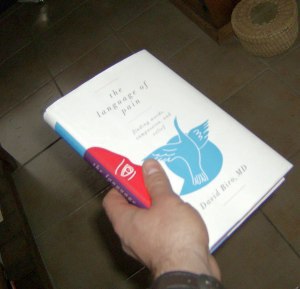
Dr. Biro has done an excellent job tackling a very difficult topic. He’s done his research – everything from the literature of Charles Dickens and and James Joyce to the paintings of Frida Kahlo to the expressions of cancer and migraine patients.
He’s also navigated the very tricky waters of philosophy. It’s easy to get lost in the never-ending mazes of philosophy, and perhaps he does get a little off-course when he touches on ultimate questions, such as God and pain. But over all, he does a remarkable job sifting through philosophy and coming up with something very practical.
That practical thing is a box of tools that you or I can use to express – and understand – our pain better. He introduces us to different types of metaphor – different ways to approach the topic.
I’m more convinced than ever, after reading The Language of Pain , that being able to express our pain is key. Key to survival, key to understanding, key to treatment – yes, even key to finding cures. As the author writes:
Physicians like me are often humbled by the uncanny sense that some patients have about what goes on inside their bodies. Deciding that something is wrong with them, or, less commonly, that nothing is wrong, patients will blatently contradict the assessment of their doctors and the “objective” data gleaned from sophisticated medical tests. Often they turn out to be right.
But many of us have only experienced the opposite side of communication. The vacant look when you try to explain. That look that says,”I won’t say you’re lying, but I know it can’t be that bad.”
The doctor that brushes you off. The employer that thinks you just want to take a day off.
But as powerful as misunderstanding can be, real communication can be just as powerful when it comes to solutions.
Dr. Biro isn’t exaggerating. If we want to move forward – and fight things like migraine – we must communicate. And it’s a skill we can learn.
It’s taken me a long time to get to this review. Not because I wasn’t interested in the topic, but because this isn’t the kind of book you can scan. It’s not a long book, but it’s not a book to rush through. You need to take the time to understand what is being said, and hopefully let it become a part of you, so that your creative expression starts to show it.
Though it’s not an easy read, it’s certainly not just a book for “artsy” people or clever writers. It’s for every patient in pain – and that’s the point.
I have a feeling this book won’t be read as much as it should be. Then again, more and more people, both patients and professionals in the health care field, do seem to be more and more aware of the necessity of clear communication. If that’s you, this is a great place to start.



 at Amazon UK.