Don’t miss this month’s Headache & Migraine Disease Blog Carnival, hosted this time by Teri Robert. There are some interesting entries, including my own. 😉
Also included is a link to the very special 2010 Migraine Poetry Contest – you won’t want to miss that!
I admit it – I’m posting 1% Thursday on Friday – but I’m still dating it Thursday so it will be easy to find. 🙂
This week – use your MP3 player [Edit: your smartphone! Remember, this post was originally written in 2010…].
Researchers tell us that distractions will lessen our perception of pain. Sounds good, but I’ve had those days where seriously I can do nothing except lie in bed – in pain. This morning, for instance.
However, there are different types of migraine attacks, and different stages. Sometimes I can use the computer toward the end of an attack (right now, for example). Or watch TV. Or half watch – with one eye – or just listen!
But perhaps my best friend has been my MP3 player. When there’s nothing else I can do – sometimes I can still listen. I might fall asleep while I listen (thank God), or it may just be a distraction.
I have a wide variety of items on my iriver clix (my MP3 player). Stories, more educational stuff, music, comedy, podcasts – who knows what you’ll be in the mood for. But it’s all there, and when I can do nothing else, and can still do something – that’s it.
Sometimes I even learn something! Imagine!
So having an MP3 player loaded up, and comfortable earphones handy, may make that 1% (or more) difference in your pain, and get you through an attack.
I hate lying in bed doing nothing (except being in pain!) – can’t stand it. So if I can squeeze another five minutes of at least doing something before the attack gets too bad – great!
What is 1% Thursday?
Every Thursday at Headache and Migraine News (weather permitting) we’ll talk about one measurable, practical thing we can do to make our lives just 1% better. Usually it will be something very easy, sometimes it will be a challenge. Let us know if you try it, or share an idea of your own – and maybe a year from now we’ll see that things have really changed for the better!
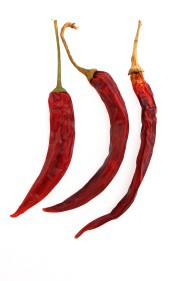
You might have heard of capsaicin – the "active" ingredient in hot peppers – as a pain causer but also a pain reliever. How can that be? And, could it be useful to fight a migraine?
Here’s the short story. Capsaicin is a proven pain-reliever. However, the evidence that it will specifically fight migraine is not as strong. However, some people do feel it helps them, and it is a natural option that you might want to try.
Capsaicin creams are often used for arthritis and cluster headache. As you might expect, it causes a slight burning feeling – particularly at first (with repeated use it gets better). But then something surprising happens – it may actually relieve pain. Why?
Capsaicin, it seems, has the ability to interrupt pain messages going to the brain. The effect is not long term, but for many people it’s long enough.
Cluster headache patients sometimes apply this cream to the nostrils. Arthritis patients put the cream over the area that hurts. It can be used several times a day.
Strangely enough, taking capsaicin supplements (such as Nature’s Way CapsiCool Controlled Heat) or even putting cayenne or other peppers in your food may help fight migraine, indirectly. Such supplements are believed to help with digestion, fight heart disease, fight bacteria, and act as an antioxidant.
You may have heard of the popular Sinus Buster products as well, which deliver the capsaicin in a nasal spray. I’ve been a little biased against Sinus Buster, partly because more than once someone has spammed me trying to promote it. Also, I have yet to see good evidence for their new product, Headache Buster, which adds feverfew and peppermint to the mix. (Don’t get me wrong – feverfew is an excellent migraine preventative. But the evidence is for specific formulations of feverfew taken as a supplement).
However, taking capsaicin in this form is an option, and it has helped some. You could try the original Sinus Buster for migraine.
Capsaicin could be tried both as an abortive or preventative for migraine.One short study on capsaicin in 2003 suggested that daily administration to the nostrils (the same as with cluster headache patients) did bring about an improvement in migraine symptoms.
If you’re thinking about using capsaicin, as always, talk to your doctor. You may want to start with a mild cream (apply using gloves to avoid irritating the skin on your hands – and don’t get it in your eyes! Ouch!) and then go to something stronger. Intranasal civamide is another newer option you can ask your doctor about.
Some available options:
Capzasin HP Creme – branded for arthritis, but a cream you could use for migraine as well. 1% capsaicin.
This is actually a replay of a tip featured here back in 2006. But actually, it’s very simple, and very helpful for some people. So here goes.
Sometimes you can’t sleep at night. You might be all sweaty, or maybe just feeling restless. Try water.
No, not to drink – well, ok – maybe that too. But on your skin. That’s right, go into the sink and splash some cool water on your skin. Arms, legs, whatever else you feel like exposing.
Then go back to bed.
This sometimes works remarkably well (seriously, it’s helped me avoid medication at times) because it cools off your skin, and that helps you sleep better – even if it’s just temporary, it may be enough.
So, next time you can’t sleep – splash it on. Don’t worry if you make a mess, it will dry by morning. 🙂
What is 1% Thursday?
Every Thursday at Headache and Migraine News (weather permitting) we’ll talk about one measurable, practical thing we can do to make our lives just 1% better. Usually it will be something very easy, sometimes it will be a challenge. Let us know if you try it, or share an idea of your own – and maybe a year from now we’ll see that things have really changed for the better!
Would you believe – a gluten-free, casein-free diet for migraine? And … um … just what is that, anyway?
First, let’s back up a step. There are a host of diets for migraine. Actually, I’d like to talk more about that in a future post. But let’s start by saying many are sceptical about these diets.
For one thing, it’s hard to get long term, scientific data about these diets. For another – they simply don’t work for everyone, no matter what some people claim.
On the other hand – diets do work for some. From my research, I remain strongly convinced that diet should be one of the key factors in your migraine treatment.
The other day I got an email from Carolyn. She says she has been migraine-free for 6 years, and healthy overall, due to a gluten-free, casein-free diet (otherwise known as the GFCF diet).
This diet is often talked about when it comes to autism and even schizophrenia. But migraine also comes up occasionally as a "symptom" in people who could benefit from the diet.
Casein is found in milk and cheese. And yes, I’ve heard people recommend cutting out dairy to stop migraine attacks as well (our friend Carolyn cut out beef as well, but that’s not standard for the GFCF diet).
It’s even harder than you think – many "dairy-free" diets still contain casein, including soy products.
The Theory Behind it All
Why this combination of gluten and casein? It’s a tricky question. If the diet does work, why?
The theory is that the GFCF diet limits opiate peptides in the body, which may be interfering with certain neurological functions of the body.
However, at this point we need more information before we can confirm exactly what is happening.
First, if you’ve tried a GFCF diet for migraine, please let us know how long you have been/were on it, and the results.
If you’re thinking of giving it a try, you already know it will be a challenge. You’ll need to do research before-hand, get products and recipes together that will make things easier, and try to find people who can support you.
You might want to try things one step at a time. Carolyn said that she started with a gluten-free diet, and found that her migraine attacks diminished. Then she moved on to the gluten-free casein-free diet ("everything from a cow", in her case).
When used for children with autism, the diet is often started the other way around (or, all at once) – casein-free first, then gluten free.
You may or may not see a change right away, and as with many things you may feel worse before feeling better. Carolyn gave a good suggestion – commit to 6 months and see how it goes.
Planning is crucial. Talk to your doctor. While she may not understand, she at least needs to know you’re going to try this.
Do your research. Just cutting out milk and bread is not enough – gluten and casein are in a great many products – but that’s far beyond the scope of this post.
Again, if you’ve tried this diet, especially if you’ve tried it for migraine, we want to hear your experiences! Please, leave a comment, or contact me here.


 (my MP3 player). Stories, more educational stuff, music, comedy, podcasts – who knows what you’ll be in the mood for. But it’s all there, and when I can do nothing else, and can still do something – that’s it.


 (currently buy-one-get-one-free)