
When Children Draw Pictures of their Headache…
We’ve talked before about the value of having children “draw their headache”. In fact, we’ve even talked about how to go about it – check out Have your child draw their headache (why and how)
Current research continues to support this idea. Why? Because clues come out in drawings that may not come out when you’re talking to the child (and vice versa). So this is an excellent thing for a doctor or specialist to try.
One interesting study was done recently at The Johns Hopkins University School of Medicine and the University of Wisconsin School of Medicine and Public Health in the USA. The study compared pictures drawn by children who had migraine, and who had pseudotumor cerebri.
The pictures were actually very similar. As you may know, both can have similar symptoms. Pseudotumor cerebri is a pressure increase inside the skull. Symptoms include headache, nausea, neck pain, seeing flashes of light, dizziness – at first glance all of which can be migraine symptoms.
But one difference stood out. 28.6% of the drawings from children with pseudotumor cerebri included crossed eyes, double images, or similar depictions of something called diplopia – that is, double vision. Only 0.6% of the migraine patients drew something similar.
That may not seem important, but little clues like that can make all the difference in early diagnosis and treatment (which is very important in both the conditions mentioned above).
So do talk to your doctor about having your child “draw their headache”. And if your doctor isn’t interested, have your child do it at home and bring the picture to the doctor. Again, here is more information on how to do it.
For more about this particular study, see Evidence of Diplopia in Children’s Headache Drawings Helps to Differentiate Pseudotumor Cerebri From Migraine
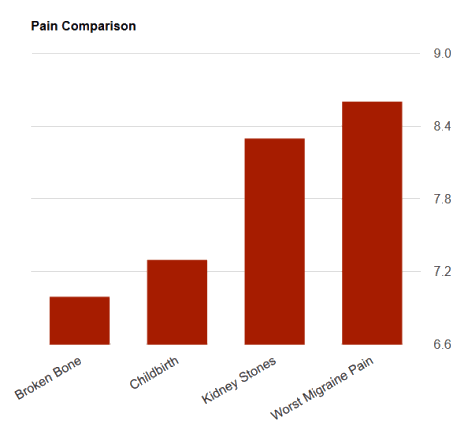 Remember, these are just averages from people who have experienced both migraine and the other type of pain.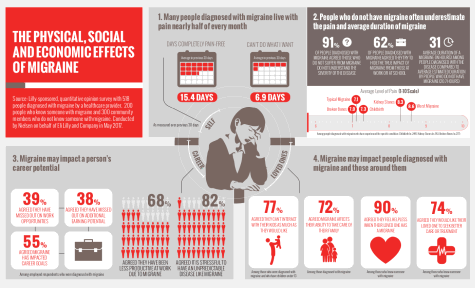
 But just how this test will be used in the short term isn’t certain. Will it actually help patients avoid a scan? Well, first patients would have to chose the slower choice – waiting several hours for blood test results instead of the much quicker scan. If it seems that the patient is likely to have intracranial lesions, will the doctor call for a scan anyway? And if they’re feeling sick and the test comes back negative, will a CT scan be called for in case they’re the 1% that the test doesn’t work for?
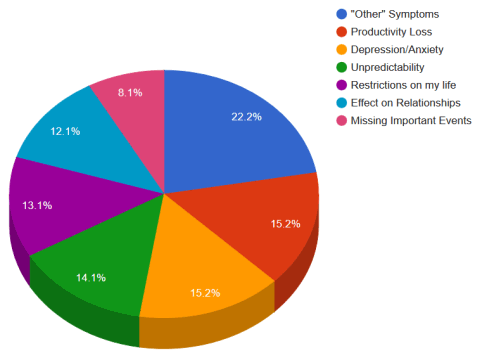 Let’s face it, there’s a lot to hate when it comes to migraine. What about you? What do you hate most?
 So amidst the ongoing media obsession with CGRP drugs, we have to ask – what’s next?