
What Triggers New Daily Persistent Headache?
By definition, a patient will know exactly when their new daily persistent headache (NDPH) began. But figuring out why it began is another matter.
We do have some good clues that at least some NDPH is genetic. But even if that’s true, why does it start – on that particular day? Is there something that happens before that which triggers it? And if so, could that knowledge help us know how to treat it, and even prevent it?
In a study published earlier this month, neurologist Dr. Todd Rozen investigated the experiences of 97 patients with NDPH; 65 women and 32 men. He found a number of triggers, some more common than others.
Just over half of the patients were not aware of a particular trigger. But there were some common themes for the others:

22% of cases started with some kind of infection, like the flu. About 9% felt their headaches were somehow related to a stressful life event. Another 9% had surgery before their headaches started (more on that in a moment).
For the rest, triggers included things like hormonal manipulation with progesterone, medications, chemical/pesticide exposure, massage treatment (!), and after fainting for some reason.
Researchers are certainly going to want to search for common threads in all of these things to better understand NDPH.
One of the interesting discoveries in this study related to the 9% who cited surgery as a trigger. All of those patients were intubated. This usually refers to endoctracheal intubation, when a tube is inserted into the mouth and trachea (windpipe). This helps the patient breath during surgery. The procedure is not without its risks – and now we’ve discovered another risk, though probably a very rare one.
If you have NDPH, do you have any idea what might have triggered it?



 The results were actually quite remarkable. Certain lipids, known as a ceramides (waxy lipids), were low in women with episodic migraine. Women with migraine tended to have less than 60% the ceramides of the controls. The more ceramides, the lower the risk of migraine.
 Now that you’re awake, the headache lasts for a few minutes – but could even last up to four hours.
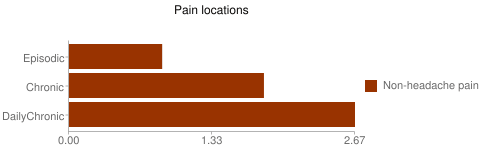 So the more chronic the disease, the more pain locations (see study at
  For each non-cephalic pain location, patients with episodic migraine were 30% more likely to progress to chronic. For patients who were already chronic, each pain location increased their odds by 6% to stay chronic. Read more at