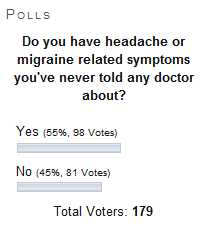
When it comes to your symptoms, have you told your doctor about all of them? Here are the answers our visitors gave in our most recent poll:
Surprised?
There are actually a host of reasons why you might not tell your doctor about your symptoms. For example:
You haven’t connected them with your specific disease/disorder
You think your doctor will think you’re crazy
You feel your doctor doesn’t have time, so you stick with the basics
You’re simply embarrassed.
You’ve had the symptom so long you think of it as "normal".
There may be other reasons too – what’s your reason?
Chronic headache disorders can be related to a host of symptoms – it really is hard to keep track of them all and remember to tell your doctor. There are many symptoms that have been related to migraine, as another example.
But one of those symptoms may be the missing connection that will bring you the treatment you need.
How do you keep track of symptoms? Have you discovered symptoms you weren’t even thinking of at first? What do you tell your doctor? Let’s discuss it!
Drug company Merck is planning to start a new trial for the drug Telcagepant this year, a spokeswoman for the company says.
We last talked about this up-and-coming migraine drug back in October (see New Migraine Drug Telcagepant – Not Dead Yet. It shows promise, but Merck stopped trials of Telcagepant as a preventative when some patients showed elevated levels of liver enzymes (read more here).
Merck took some time to discuss options with FDA (USA) officials. After some months, they have decided to go ahead with another safety trial in 2010, though they’re still working to design the study.
Telcagepant is one of a group of drugs called CGRP receptor antagonists. Many patients who haven’t benefited from triptan type drugs are looking forward to trying Telcagepant. However, researchers are also interested to see how Telcagepant and other CGRP receptor antagonists will work along with triptans.
Stay tuned to find out more about this upcoming study, and the results. Also, we hope to see other drugs in this class researched for migraine.
Today I was standing in line at the bank. On the back of someone’s t-shirt I read,”Pain is weakness leaving the body.” The quote has been made famous by the US Marines.
All right, I know what they’re trying to say. But if pain is weakness leaving the body – why do I feel so much weaker today (post migraine attack) than I did Saturday (pre-migraine attack)?
You might actually be surprised how much debate there is over how to define pain. What is pain? Is it a warning – something that keeps us from harm? Yes, sometimes. But sometimes pain causes the harm, it seems. Or even takes on a life of its own.
Pain, whatever it is, drives us inside ourselves. No one understands, and words seem to go from a stream to a trickle until they finally dry up.
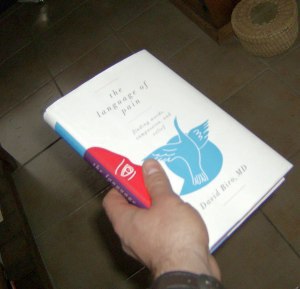
Perhaps a good introduction to the book is in the author’s postscript:
… At its most intense, there is no time to think, let alone try to represent how one feels. … So why bother trying to speak? Why not just close one’s eyes, as I did many years ago in my hospital room, and wait for it to pass? And for those who witness pain, why bother trying to break down the wall of private experience and attempt to share what cannot be shared?
The simple answer is that we must. We must because the consequences of not trying are too great…
We must… but — how?
The goal of the book, if I could summarize it, is to free our tongues so that we can talk about pain (or draw, pain, sing, – most forms of expression fit in this case). Not only talk about it, but talk in ways that help us to understand it better. To deal with it better. And to share in ways that help others understand a little better – doctors, friends, family – the world.
It’s amazing that such a big topic hasn’t been discussed more. Don’t get me wrong – art, visualization, conversations of all kinds have been going on throughout history, and are strongly in the mainstream of medicine today. But the how – how to express pain – it’s a topic we don’t talk about enough.
Dr. Biro has done an excellent job tackling a very difficult topic. He’s done his research – everything from the literature of Charles Dickens and and James Joyce to the paintings of Frida Kahlo to the expressions of cancer and migraine patients.
He’s also navigated the very tricky waters of philosophy. It’s easy to get lost in the never-ending mazes of philosophy, and perhaps he does get a little off-course when he touches on ultimate questions, such as God and pain. But over all, he does a remarkable job sifting through philosophy and coming up with something very practical.
That practical thing is a box of tools that you or I can use to express – and understand – our pain better. He introduces us to different types of metaphor – different ways to approach the topic.
I’m more convinced than ever, after reading The Language of Pain , that being able to express our pain is key. Key to survival, key to understanding, key to treatment – yes, even key to finding cures. As the author writes:
Physicians like me are often humbled by the uncanny sense that some patients have about what goes on inside their bodies. Deciding that something is wrong with them, or, less commonly, that nothing is wrong, patients will blatently contradict the assessment of their doctors and the “objective” data gleaned from sophisticated medical tests. Often they turn out to be right.
But many of us have only experienced the opposite side of communication. The vacant look when you try to explain. That look that says,”I won’t say you’re lying, but I know it can’t be that bad.”
The doctor that brushes you off. The employer that thinks you just want to take a day off.
But as powerful as misunderstanding can be, real communication can be just as powerful when it comes to solutions.
Dr. Biro isn’t exaggerating. If we want to move forward – and fight things like migraine – we must communicate. And it’s a skill we can learn.
It’s taken me a long time to get to this review. Not because I wasn’t interested in the topic, but because this isn’t the kind of book you can scan. It’s not a long book, but it’s not a book to rush through. You need to take the time to understand what is being said, and hopefully let it become a part of you, so that your creative expression starts to show it.
Though it’s not an easy read, it’s certainly not just a book for “artsy” people or clever writers. It’s for every patient in pain – and that’s the point.
I have a feeling this book won’t be read as much as it should be. Then again, more and more people, both patients and professionals in the health care field, do seem to be more and more aware of the necessity of clear communication. If that’s you, this is a great place to start.
On March 17th 2010, the journal Cephalalgia published two studies on Botox from the PREEMPT 1 and 2 trials. These are both phase 3 studies, and it’s still looking good for Botox.
Both of the trials were for chronic migraine sufferers. The patients were given Botox injections every 12 weeks.
The PREEMPT 1 trial found a significant decrease in days with headache and migraine, hours of headache and moderate to severe headache days. Though actual number of attacks were not significantly lessened, the attacks were lessened quite a bit.
The PREEMPT 2 trial also found a significant decrease in headache days within a 28 day period.
More good news – very few patients had problems with the injections (ie side effects) that were significant enough that they stopped the trial.
At one time, the PFO closure seemed like one of the most hopeful treatments for migraine. With a simple surgery, could your migraine attacks disappear?
PFO stands for patent foramen ovale, and the surgery closes a common "hole in the heart". When some patients getting the surgery reported that their migraine attacks had gone away, research was started to see if this treatment might hold the answer for a lot of migraineurs. (read more about what we said about PFO surgery in this edition of HeadWay back in 2003)
But the results of the research was unimpressive. Trials were cancelled. And patients started to look elsewhere.
But is this line of research dead? Should we be taking a closer look?
Researchers in the Department of Cardiology, University of Palermo (Italy) have decided to take a closer look, both at stroke patients and migraineurs who have PFO. The question is, what is their condition like? Not all PFO is the same – what if migraineurs with a certain type of PFO would benefit from surgery?
What the researchers did is compare migraineurs with patients with ischaemic stroke. Then they categorized the group by a couple of different factors – "embryonic recesses" and the severity and size of the PFO.
The results they found didn’t point obviously to which patients would benefit most from surgery, though the obvious answer would be those with the most severe PFO. However, it at least demonstrated the fact that both stroke and migraine patients varied quite a bit in a) whether or not they even had PFO (about 2/3 or migraineurs didn’t) and what type of PFO they had.
So the next step? Find out which patients benefit more from the simple surgery. What if, for example, 75% of patients with large PFO and migraine would find relief from surgery, while the others would not? It would be a big reason to avoid surgery in patients without severe PFO, and a big reason to give it a try in patients with severe PFO.
We’ll be watching for further research to tell us if PFO closure may still be promising for a large group of migraineurs.


 at Amazon UK.