I admit, sometimes I’m not the master of brilliant headlines. But this recent study is interesting and helpful, even if it’s a little hard to describe in a few words.
Researchers and Australia and the Philippines decided to study the changes in migraine and tension-type headache over a period of 6 months. 79 patients were in the study. The question was – how much do symptoms change over the course of a few months, or from one day to another? Are there any factors that we can see that could explain why one condition improves and another does not?
Of the two, migraine was certainly the most volatile from day to day, with the most change. But both conditions saw a lot of change (not surprisingly) over the course of 6 months.
But perhaps the most interesting finding was one factor that predicted whether the patient would be more or less disabled after 6 months.
Before the six months began, patients were checked for “cervical musculoskeletal impairments”. In other words, which patients had neck trouble – a problem with range of motion, dysfunction.
Patients with cervical joint dysfunction were far more likely to be just as disabled at the end of 6 months as they were at the beginning – 6 times more likely.
If this is impeding your improvement, it’s probably time to talk to your doctor and a physiotherapist to see what you can do to improve the situation. It could be that neck problems are triggering a pain cycle and making your headache condition worse.
Neck pain is extremely common in migraine in particular, but it’s often ignored. Paying attention and looking for treatment could make a big difference in your path to health.
Today I would like to respond to a question that was asked recently (if you would like to ask your own question, just go here). Questions like this are, sadly, quite common.
This time I’m going to post the question in full, but I’ll protect this person’s privacy and not include a name.
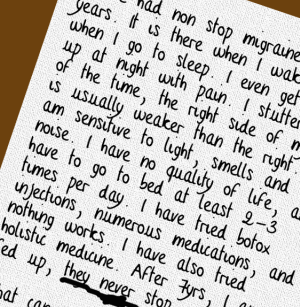
I have had non stop migraines for 7 years. It is there when I wake up till when I go to sleep. I even get woken up at night with pain. I stutter most of the time, the right side of my body is usually weaker than the right. I am sensitive to light, smells and noise. I have no quality of life, and have to go to bed at least 2-3 times per day. I have tried botox injections, numerous medications, and nothing works. I have also tried holistic medicine. After 7yrs, I am fed up, they never stop. What can I do? I am desperate for help. I have also had CT scan’s, M.R.I’s that just show some white spots on the brain. I am told not to worry about this.
I know many of you feel like this person. Obviously I am not going to give custom medical advice here – neither am I a doctor, nor do I have enough information. But there are a few general things I would like to say that hopefully will be a help to some of you.
When you feel “desperate”: It’s not at all unusual to feel like there’s no hope. But I can tell you from many years of experience that I’ve heard from many people who felt that there were no more options who finally found significant or complete relief from their disabling and painful symptoms. There is hope! Yes, there may be times when you need to take a break from treatment, and “trying the next thing”. But on the other hand, don’t fall into the trap of trying whatever you see on the internet or in a magazine because you’ll “try anything”. We’ll talk about that more in a moment.
Find a specialist: This person didn’t mention specifically their experience with doctors, but for many of us it may be time to either find a good specialist, or find a new one. In this case, it’s critical to find someone who won’t give up. If a doctor tells you that you’ve “tried everything” and that there’s nothing else they can do – find a new doctor now. There are still options.
Medical clues: This person already has an advantage – they are obviously thinking about their symptoms, past treatments, etc. Believe it or not, many people don’t take the time to think through these things. There are numerous things that could help a specialist find answers here. For example, some important clues: pain waking you up at night. Weakness on one side of the body. Length of time with symptoms. Persistence of symptoms. Write these things down (the more organized the better), along with any other symptoms, and the medications you’ve tried (the more details the better). Consider either a written migraine diary, or an app such as Curelator.
Scans:Scans for migraine are rarely necessary, unless your doctor has good reason to suspect another condition that would show up in a scan. The “white spots” on the brain likely refer to lesions that are common and probably not the cause of your symptoms. However, because they are common in migraine patients, they are another indicator that migraine is serious and should be treated (see more on brain lesions here).
Step by step: It’s very important to take an organized, step by step approach to treatment whenever possible. We’ve basically covered this above, but again it requires a doctor or specialist who is informed and won’t give up, a patient who is informed and won’t give up, and paying careful attention to past treatment, past and current symptoms, and medical history.
Immediate action: Waiting to see if a new treatment will work, or waiting to see the doctor, can be frustrating. Many supplements, medications and other treatments need to be tried for at least 3 months to really see if they’re helping. So what can I do now? I would suggest two powerful things that you can work on now. Moving, and Connecting. We’ll talk about these below.
Don’t be overwhelmed by the information that’s out there. Again, it’s a step by step process. But let’s look at those two things I mentioned that should go along with your continued search for answers.
(1) Moving It’s simple – moving your body. I’m not talking about making a resolution to go to the gym for 5 hours a day. I’m talking about any increased movement whatsoever.
This is seriously one of the most powerful things you can do for your quality of life. It can be as simple as this: Go for a walk for 3 minutes today. Two days from now, make it 4 minutes. Two days later, 5. Don’t suddenly jump into major exercise. Find some great music to listen to, and vacuum the floor for a few minutes. Go up and down the stairs. Whatever works for you. But just do a tiny bit more. If you miss a week or two, start again. It will make a big difference, and you can do it now.
(2) Connect Connecting with other people is my other “right now” suggestion. I’m not talking about Facebook or a forum, although these things have their place. Connect with someone face to to face. Even if it’s only once a week, though it should be every day eventually. If you need to find someone who doesn’t mind that you’re in bed, invite them over for 10 minutes to help you with something tomorrow. Make it clear that you can only handle 10 minutes. Better yet, if you can, help someone else with something for a few minutes. Connecting is very important.
Obviously there are hundreds of articles here with information about treatments and advice on improving quality of life. These are just a few highlights. Feel free to leave a comment with your own thoughts, whether you have a success story, or whether you’re just trying to make this week a little better than last week.
Most people know CPAP (Continuous Positive Airway Pressure) as a treatment for sleep apnea. Essentially, a machine connect to a mask, which pumps air under pressure to the lungs, keeping the windpipe open while you’re asleep. The windpipe remains “unobstructed”, thus helping with obstructive sleep apnea.
Illustration courtesy PruebasBMABut over the past few years, patients and researchers have become interested in another aspect of CPAP machines. That is, their relation to headaches.
There are three aspects to this question:
Could CPAP machines actually cause headaches, or at least make them worse?
Is sleep apnea related to headaches and migraine? In other words, could treating sleep apnea also fight headaches?
Could CPAP machines be a treatment for headaches, migraine, and even cluster headache?
Let’s start with #1. Yes, some people have noticed an increase in headache symptoms when they use the CPAP machine. This shouldn’t be surprising – any significant change can certainly trigger an attack in people with migraine disease.
However, there may be some good solutions (besides avoiding CPAP treatment). One would be “giving it time”, of course, but one business focused on sleep related medical equipment reports that there could be a simple solution:
Sinus systems extend behind your ears. When a CPAP is used and part of the sinus cavities are blocked, a situation is created where there is a pressure differential between the sinus cavities affected. These pressure differences can sometimes be felt as sinus headaches or just plain headaches, even though they are caused by sinus blockages. These can be treated using over the counter medications to open the sinus. CPAP heated humidifiers can also open and maintain sinus systems. If you do not use a heated humidifier, we strongly suggest using one. If this does not correct the problem, visit your ENT. [Why do I have a headache when I wake up?]
These are common recommendations from both companies with experience and doctors. Check if a pressure adjustment is needed, and consider a CPAP heated humidified (and make sure it’s working properly).
Also, you may have a reaction to the straps used for the mask. See if you can loosen them or try a different type of mask/strap.
While a temporary increase in headache symptoms may be common, it’s also common that headache symptoms decrease – or disappear – when a patient starts using a CPAP.
It seems that sleep apnea (sleep apnoea) is a significant trigger for headache attacks, such as those from migraine. In 2013, for example, a study was released that showed significant improvement in migraine patients with sleep apnea who started using CPAP (CPAP Improves Migraine Burden in Patients With Sleep Apnea). Another study also found that patients with obstructive sleep apnea and migraine often improved significantly if they were committed to CPAP treatment.
Could CPAP work specifically as a treatment, even if patients aren’t diagnosed with sleep apnea? And which patients are most likely to benefit?
Much more study is needed, and some studies are beginning. For example, a CPAP study in Norway will be evaluating the use of CPAP for cluster headache treatment.
In the mean time, it’s very important for doctors to pay attention to the sleep patterns of headache patients. There are probably a high number of patients with headache symptoms who have undiagnosed obstructive sleep apnea. In fact, doctors could make a lot of headway just by asking a simple question – When you woke up this morning, did you feel refreshed?
Some doctors have recommended lipoic acid as a supplement treatment for migraine. So what exactly is it?
Alpha-lipoic acid (also known as thioctic acid or ALA, or there is also RLA, the naturally-occurring version) is a chemical that is found in some plants, and actually is made by your own body. It’s an antioxidant, and so helps keep your body healthy while it fights inflammation. It also helps your body maintain proper levels of vitamin C and vitamin E. Both of these may play a major role in fighting migraine and headache.
Now, we’re all for antioxidants and healthy foods, but why ALA in particular? And why haven’t you heard about it from your doctor?
The evidence for ALA for migraine is still fairly sparse, just because there haven’t been many studies on it. A study in 2007 suffered because not enough patients were recruited for the study. However, the study seemed to show fewer headache days, and less intense headaches, with ALA. This was over 3 months (see A randomized double-blind placebo-controlled trial of thioctic acid in migraine prophylaxis..
600mg was also the amount used in the migraine study.
Because lipoic acid comes from food, your best bet is probably to eat more ALA-rich foods. Broccoli is one of the best all-round foods for a migraine patient. Also try organ meat (liver, heart), spinach, and tomatoes.
So here are some things to consider:
Get ALA from food. This is almost a no-brainer, since we already know that foods like broccoli have so many benefits. Also try adding peas, brussel sprouts, carrots and beets to your diet.
ALA can be taken as a supplement for general health. You could try 50-100mg per day.
If you would like to try ALA specifically for migraine prevention, talk to your doctor about a 600mg dose.
Which supplement? An excellent version of thioctic acid is Country Life R-Lipoic Acid. It contains no gluten or milk or preservatives and is vegetarian. It’s also one of the less-expensive versions of RLA, and was tested and approved by Consumer Lab.
If you’re taking a higher dosage, an even less expensive version (also tested by Consumer Labs) is Vitacost Alpha Lipoic Acid. This would be a good option if you’re going the 600mg route, because you can take it in two doses.
Finally, if you’re looking for one of the highest rated brands on Amazon, Doctor’s Best has a whole series of lipoic acid products to choose from. The reviews themselves are an interesting read, if you want to hear about how this supplement is actually helping people.
One of the interesting revelations at the 18th Congress of the International Headache Society this September in Vancouver was that we should seriously think about exercising less. Well, for less time. Sort of.
Most of us already know that the most amazing “pill” to take to keep the migraine monster at bay is exercise. Just a little more movement every week can make a huge difference over time.
But those who want to get some serious exercise in over the course of a week often have a problem. Well, a few problems maybe. But for the purpose of this article, the problem is time. Where in our busy (and often migraine-interrupted) schedules are we ever going to find time?
Yes, we know that the exercise will pay off – fewer migraine days, more energy, being more alert and productive. But sometimes that isn’t enough to motivate us.
But this study out of Switzerland might help a little.
The study of 20 women and 4 men included two different exercise plans:
45 minutes twice per week = 90 minutes per week
28 minutes twice per week = 56 minutes per week
Both groups saw a significant improvement – fewer migraine days. But the second group experienced a MUCH greater improvement.
What’s the catch? Well, the catch – sort of – is that both groups burned the same number of calories. In other words, the second group had more intense exercise.
The group that improved the most used HIT, or high-intensity interval training . But remember, they exercised less per week and had a much better result. In fact, over a year, they would exercise for 26.5 hours less than the other group – that’s more than a day of your life. (Actually, almost two days, depending on how much sleep you get!)
Why the difference? Lead author Alice Minghetti explains:
After you do high-intensity training, your body for a long period has to have certain adaptations in your system, so you need more oxygen after the workout than you do when you have just continuous, moderate-pace exercise. So especially for people who are busy or actually enjoy high intensity…it’s a better exercise regimen.
The drawback for migraine patients is that our brains don’t like change. Sudden changes such as those in high intensity training could trigger attacks in some. But remember, these were migraine patients. And even with that issue, headache days were fewer with either kind of exercise.
So, if you can, give it a try. If you just can’t – increase your exercise – or any kind of movement – little by little. It may be your best treatment.

 Before the six months began, patients were checked for “cervical musculoskeletal impairments”. In other words, which patients had neck trouble – a problem with range of motion, dysfunction.
 This time I’m going to post the question in full, but I’ll protect this person’s privacy and not include a name.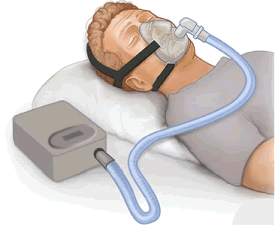
 Now, we’re all for antioxidants and healthy foods, but why ALA in particular? And why haven’t you heard about it from your doctor?
 Most of us already know that the most amazing “pill” to take to keep the migraine monster at bay is exercise. Just a little more movement every week can make a huge difference over time.