Eye Redness and Headache
What does it mean when you have eye redness and headache? Answering the question quickly was my challenge. Here’s my first try at a quick tip feature which I would like to do regularly here at Headache and Migraine News…
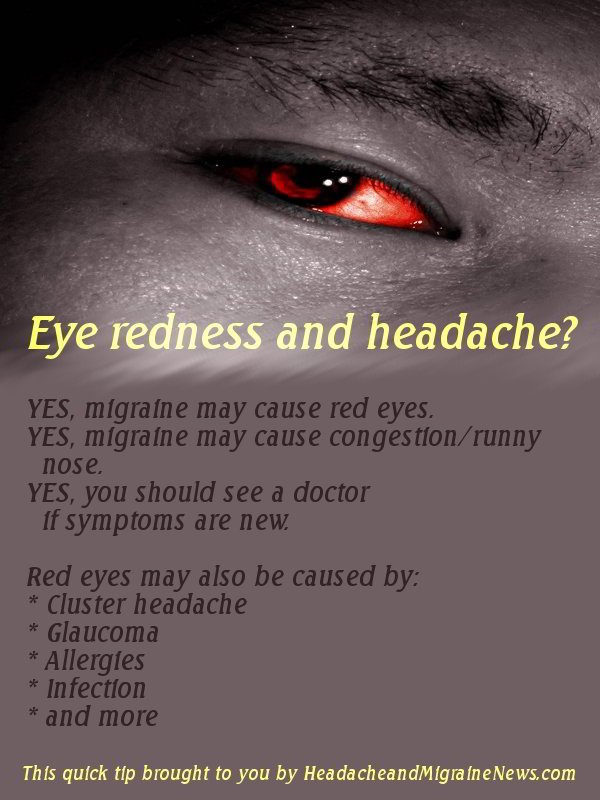

What does it mean when you have eye redness and headache? Answering the question quickly was my challenge. Here’s my first try at a quick tip feature which I would like to do regularly here at Headache and Migraine News…
Are painkillers not being given to patients who really need them? Or are they given out like candy to patients who don’t need them?
 |
The answer is very likely “Yes”.
A recent article by Sophie Borland in the UK claims We’re a nation of painkiller addicts: Doctors writing 62million prescriptions every year. Often, the article states, doctors sign pages and pages of prescriptions given to them by the nurse without checking the details. Many patients are “addicted”, and many won’t tell their doctors how many drugs they’re actually taking.
Yes, we are right to be concerned about doctors who assume patients are “addicted” to painkillers (usually the actual definition of “addicted” is somewhat vague), and so refuse to give medication to patients that could really benefit.
At the same time, patients taking the wrong medications, or medication they don’t need, is a serious, growing problem.
So how can a doctor find a balance? There are patients who are taking medications that are doing more harm than good. There are others who can’t access the medications they truly need.
I don’t believe this issue will be solved by new laws restricting drugs, or by insurance companies creating more policies.
What is really needed are patients who know how to communicate with their doctors, who have organized their medical history (and family medical history) and who keep track of their symptoms and treatments. And we need doctors who will take the time to listen to their patients, take their patients seriously, and take time to find solutions instead of saying take two and call me in the morning for every headache.
Calling all doctors and patients in 2013 – will you take the challenge? It might mean more time, it might mean less money, it might mean taking the long view instead of looking for short term results. But it also might mean that more people that need to be treated will find a solution this year.
More thoughts to ponder:
How much sleep should the average person get per night? Or should we say, per day (since many studies highly recommend naps)? Should people with chronic pain get more sleep? Or is over sleeping causing more problems?
Required sleep has been a hot topic for years. Some people claim they can get by with 4-5 hours of sleep (thus “adding” many more hours to the day), others say 7 is preferable, there’s the typical 8 hours, and others who say 9 or 10.
 |
But an interesting study on sleep published in December edition of the journal Sleep is suggesting that, when it comes to pain, more may mean less.
18 healthy volunteers were in the study. Some had their normal bedtimes for four nights, others had an “extended bedtime”.
On days 1 and 4 the patients took the Multiple Sleep Latency Test (MSLT), which measures daytime sleepiness. This test is administered several times throughout the day. They were also given a standard pain sensitivity test.
The group with the “extended bedtimes” slept 1.8 hours longer than the other group. And – you got it – they were less sleepy during the day, and they were less sensitive to pain.
And we’re talking significantly less. The study was then compared to other similar controlled studies, and the researchers concluded that the extra sleep was a better “painkiller” than 60mg of codeine. Yes, that’s a fair bit of codeine.
Now this test is important for those who are recovering from surgery, for example. Doctors can tell them to try getting more sleep during their recovery time.
But what about those with chronic headache or migraine?
Many people actually find that over sleeping makes migraine worse. And doesn’t it also make you dopey during the day?
Both these things are true, but neither mean that you can’t get more sleep. Here’s how you can benefit instead of getting worse:
Just for the record, according to the Mayo Clinic, the average amount of sleep the average healthy person should get is 7-9 hours for adults, 10-11 hours for school age children, 12-14 hours for toddlers, and 14-15 hours for infants. Which means – if you have chronic pain – you might want to aim for the higher numbers.
New year’s resolution? 🙂
Your child is getting frequent headaches? Especially while they’re working on homework? Looks like they need eye glasses – right?
Actually, probably not.
Earlier this month, a study was presented at the 116th Annual Meeting of the American Academy of Ophthalmology. The records of 158 children were reviewed who had come to the ophthalmologist because they had frequent headaches.
 |
All the children were given an eye exam.
Most of the children did not have problems with eyesight (problems that had not already been corrected – some did wear glasses). About 14% said that they had headaches when doing homework and other visual tasks. But a need for vision correction was not the primary cause of the headaches – in ANY of the cases!
Researchers noted that for most of these children the headaches did lessen over time – but getting dealing with vision problems did not mean they were any more likely to resolve.
The take-away? If your child is having frequent headaches, it’s very unlikely that vision problems are the issue. Of course, your child should have regular check ups for eyesight. But don’t wait for new glasses to deal with headache problems.
If your child has frequent headaches, it’s not normal. Take your child to a doctor right away. If your doctor brushes it off as nothing, seriously consider a specialist. The earlier you can catch headache problems, and treat them, teh better.
via Children’s Headaches Rarely Indicate a Need for Eyeglasses, Study Finds
Yes, those leftovers lurking in your fridge may be migraine triggers. The fact is, good food – healthy food – may change in subtle ways while it waits to be noticed. A friend may turn into an enemy.
 |
For example, tyramine (a potential migraine trigger) is a compound in foods that increases as food ages. And it doesn’t have to age very long. After 24-48 hours, it’s wise to avoid refrigerated leftovers – yes, even if they’re not “bad”. This especially includes high-protein foods.
But that’s not all. If foods are just a little “off”, that could cause stomach problems – which could in turn trigger headaches.
So what should you do? Here are some quick tips:
Eat all perishable foods within 24-48 hours of purchase. No, cooking does not remove tyramines.
Meats that have been in the fridge for more than 48 hours. If you’re not going to eat them that soon, freeze them. Fresh meats or pre-stuffed meats should be cooked within 24 hours of purchase.
Some foods, like cheeses and lunch meats, are designed to last longer. However, they tend to trigger migraine attacks to begin with. Be wary of anything that is aged.
Be sure food gets back in the fridge as soon as possible – don’t leave it on the counter. It may look fine, and smell fine – but bacteria is growing.
Make sure the temperature of your fridge is below 40°F/4.5°C. If food gets above this temperature for 2 hours or more (for example, due to a power outage), don’t eat it (even if it looks fine). Taking something home from the restaurant? If it isn’t in your fridge within two hours, forget it.
Yes, you can put hot food in the fridge. Another option is to quickly cool the food in ice water. Use small/shallow containers so that the food cools as soon as possible.
Don’t pack your fridge completely full – there needs to be room for cool air to circulate.
Clean out your fridge regularly.
Invest in a freezer, and use it often. Freeze leftovers right away in small portions, and thaw them when you’re ready to enjoy them.
Enjoy your leftovers! But remember, the fresher the better – especially for a migraineur. Easy post-holiday meals can quickly become a nightmare.