In her case, it wasn’t too difficult, but it took so long because food intolerance isn’t generally the first thing your doctor looks for. They may suggest some of the common migraine food triggers early on, but that’s not quite the same thing.
Christy ended up trying something that most of us have heard of, but many of us have never tried – an elimination diet. This isn’t just avoiding triggers. It’s avoiding the most common foods that cause problems, and then gradually re-introducing them.
Elimination diets track foods that are considered to be responsible for 90% of food allergies. Now, you may not have an allergy, but these foods may still cause problems, such as…
Migraine
Fatigue
IBS
Insomnia
Joint Pain
Acne
Heartburn
So the plan is to cut out the following foods – 100% – for three weeks. That means carefully reading labels, and never cheating. It’s not long – you can do it!
Then you introduce one of the foods back into your diet for 2 weeks. Keep a diary – are any symptoms bothering you? If you’re good after a couple of weeks (there may be an adjustment period at the beginning), go on to the next food.
What follows is a typical list of 12 items. However, it’s not a complete list. Talk to your doctor for ideas. You might want to try these things first, and then move on to other possibilities as your doctor directs. You don’t want to get overwhelmed with an endless list right at the beginning.
A new study takes a look at an important question – after 10 years, which migraine patients have significantly improved – and why?
It’s important to remember that when it comes to conditions such as migraine, patience is important. A true, lasting, significant improvement can take time – but it’s worth it.
We’ve talked about the opposite before – what makes migraine worse? Specifically, what makes it become chronic? Genetics plays a big part, but there are other factors, such as sleep disorders, depression, obesity, and poor treatment.
First of all, the bad news. Less than half of patients were significantly better. Now, that’s not quite as bad as it sounds – the researchers were looking for a significant improvement – days with migraine at least cut in half.
Still, that percentage is way too low, and there is good reason to believe that good information and quality treatment could have made things much better.
That being said, it was helpful to see a couple of the key things that made a difference:
NOT SMOKING: One of the biggest commonalities among those who improved significantly vs. those who did not was that the improved group did not tend to be smokers. This issue has been discussed for a long time in migraine research, but probably not enough. And it should be noted that turning to vaping is not the answer – vaping commonly triggers headaches. Your goal, even if it’s a longer term goal that you’re aiming for, should be to avoid smoking and vaping altogether, if you want to be free of migraine attacks.
MEDICAL FOLLOW-UP: Another major factor was something as simple as going back to the doctor. Just showing up. There could be a number of reasons for this. But as we mentioned above, migraine treatment is usually a long term process (as with many neurological issues). Going to a doctor and getting a prescription and never doing anything else is apparently a huge barrier to actual significant long-term improvement.
Another note on #2. Patients who started with more migraine attacks per month were also more likely to see significant improvement. Part of the reason could be that these patients are more likely to take migraine and its treatment more seriously. But remember, even a couple of days a month lost to migraine has a major impact over the course of a year – and a lifetime! Everyone should take fighting migraine seriously.
Although treating migraine may take time, and does require patience, don’t assume it’s going to take many years. It is hoped that migraine treatment for most people will bring an improvement in much less time.
And now we’ve learned two more keys – make a plan to quit smoking if you do, and don’t give up on improving your treatment as the years go by. There is hope – don’t give up the fight!
(Speaking of not giving up, remember that the Migraine World Summit starts this week – click the link to register for free, and make it your next “virtual” follow-up doctor’s appointment, with some of the world’s foremost experts!)
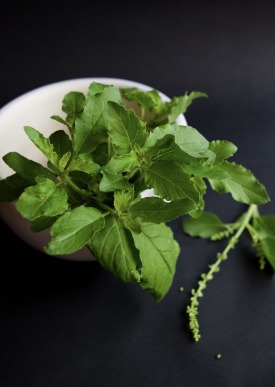
Tulsi tea*, a common tea in India, is a traditional headache remedy. But what is it?
Tulsi is a type of basil. Not exactly the kind you typically cook with, which is sweet basil, but a different variety called holy basil (ocimum tenuiflorum). It is sweet and aromatic, and can be used in hot tea or iced tea.
Using basil for migraine is actually fairly common. You may remember that Drs Young and Silberstein mentioned a basil oil massage in their book Migraine and Other Headaches. Some people use it in diffusers, and yes, some cook with it.
Aside from headaches, holy basil may have other benefits that migraine and headache patients may be interested in. It may help decrease inflammation, and help with stress and anxiety. There is even some evidence that it could help prevent cancer. (Read more: 10 Holy Basil Benefits: Tulsi Helps Anxiety, Acne & More and Holy Basil)
To make tulsi tea*, use about a tablespoon of dried leaves per cup, and pour freshly boiled water over. Brew for 5-10 minutes, or longer. For an iced tea, use double the leaves, let it cool, and add ice.
* Yes, I’m aware that “tulsi tea” is not actually a tea, but a tisane. But it is commonly known as tulsi tea. Which does have a ring to it, even if it’s wrong. However, maybe you should tell your friends that you’re making a tulsi tisane, and impress them with your smarts (which may be another benefit of tulsi tisane – increased mental powers).
Many people believe having a drink or two after dinner or before bedtime will help them sleep. This couldn’t be further from the truth. Alcohol is a sedative. In early stages of consumption, alcohol sedates your prefrontal cortex — the part of our brain that controls our impulses and helps us think and plan. With time, alcohol starts to sedate other parts of our brain, effectively sedating you out of wakefulness. However, the brainwaves produced during sedation are not what we experience in natural sleep. In fact, when we are “sleeping” under the influence of alcohol, we experience frequent awakenings, which impairs our ability to receive restorative sleep. Because your brain is still sedated, however, you do not remember them, causing you to believe you slept well, which is why many people have trouble realizing the “hangover” they experience the next day is in part due to their poor sleep…
Dr. Nicole Moshfegh
Dr. Moshfegh goes on to explain how alcohol can interrupt the deep “REM” sleep that we need.
What about cannabis? Dr. Moshfegh addresses this as well, which acknowledging that we still have a lot to learn about the relationship between cannabis and insomnia:
Here’s what current research has provided evidence so far: Sleep disturbance is a known withdrawal symptom of marijuana use (even when exposed to low doses); THC is associated with daytime sleepiness, delayed sleep onset, and a decrease in slow-wave (or restorative) sleep; and any short-term benefit marijuana users may initially experience (typically decreased sleep onset) vanishes after long-term/chronic use, due to a buildup of tolerance…
Dr. Nicole Moshfegh
So even low doses of cannabis may lead to withdrawal on certain days. And as with alcohol, you may “get to sleep” quicker (at least in the early stage of cannabis use), but that sleep will not be quality sleep.
Because sleep is so important for migraineurs, we should certainly think twice about anything that will take away from quality sleep time. And a key way to test the sleep you’re getting is to ask the question, “When you woke up this morning, did you feel refreshed?“
If not, you may have good reason to look into ways to improve your sleep. You may need to consult a sleep specialist. Of course, there are also more tips in Dr. Moshfegh’s new book, which was published in October.
Last time we talked about our overall plan for quitting sugar – which actually includes quitting sweeteners as well. I didn’t go deeply into the science of all this – you can find that in other posts and other places on the web. Our purpose in these articles is to talk about strategy.
Candy or almonds or neither? Time to get specific…
We have talked a little about preparing to quit sugar and sweeteners, and preparation is very important if you want to succeed. And you can’t just think about “cutting” things – you have to think about the big picture of what you’ll eat.
This is where things get tricky, because a lot of the advice you’ll see online is based on goals that are entirely different than ours. What is our purpose? To fight migraine, of course.
So when you’re looking at various food lifestyles online (forget about diets – we want to change the way we eat), you’ll see a lot of great ideas for “losing weight” (often very temporary solutions, as statistics show). You might want to lose weight, but that’s not our goal.
Or, and this is a classic, people buy into a different type of “diet” and then try to find ways of eating exactly what they did before. That’s why, when you look up recipes for a popular diet, you instantly find brownies, cheesecake, banana bread and chocolate chip cookies. (I still get a chuckle at the number of gluten free cookbooks that feature things like brownies on the cover! — gluten free? Yes. A healthier food lifestyle? Maybe not!)
So our purpose is to fight migraine, and we know that messing with sugars and sweeteners is a huge factor for many people. And that includes refined flours.
This post will get too complicated if I tell you exactly what to eat. You already have your ideas about what is healthy and what is not, and the research is continually changing our ideas about what we should be eating. But you do want to avoid the classic mistake – cutting out sugar, and then filling up on sweeteners and smoothies and juices and “sugar free” breads. FAIL.
So do your research, make a plan for your new migraine-fighting food lifestyle, and download a few recipes. For me personally, not having to think too much about breakfast is important, so one of my first priorities is to know exactly what I’m going to eat/drink during those first hours of the morning.
Collect some recipes ahead of time. Consider how you will “switch out” those quick convenient meals/snacks for something that fits your new healthier way of eating.
I will make one recommendation. A lot of migraine patients are using The Migraine Miracle by Dr. Josh Turknett and Jenny Turknett. This book is written by a neurologist and migraineur (who has found tremendous relief), as as the longer title shows, it fits perfectly with our strategy – “A Sugar-Free, Gluten-Free, Ancestral Diet to Reduce Inflammation and Relieve Your Headaches for Good”
This particular food lifestyle is a kind of paleo diet, but it’s specifically designed for migraine patients, with an acute awareness of triggers and what current research is telling us about migraine. It also explains some of the reasons why we’ll want to quite sweeteners as well as sugars, at least for a few months (as we discussed in the first article).
The book does have recipes, and they’re excellent, though some are quite time consuming. If you like what you’re seeing in the book, you can certainly go out and find your own recipes for free that follow the philosophy of the book. Also, Dr. Turknett has a subscription based service which will provide you with an avalanche of excellent recipes – both easy and complex, dairy free or not, snacks and main courses – worth looking into if you would like to take this path. (And the recipes come from Jenny, who obviously knows exactly what she’s doing!)
(The subscription also takes you through a lot more of the philosophy behind this type of migraine-fighting eating, which will be tremendously helpful if you want to be successful long term.)
So today’s goal – continue to prepare, by thinking specifically about what style of eating is best for you, and what exactly you’re going to eat. Many migraine patients are finding major success by getting serious about what they eat. But if you start without being ready, you’ll only be planning to fail.
If you’ve found success with a particular sugar-free style of eating, let me know! I would love to hear your story.