Even for those of us that try to keep track of migraine, cluster headache or whatever-kind-of-headache symptoms from day to day still miss these. It’s usually not hard to miss the main symptoms – headache, dizziness, nausea – whatever it is for you. And quite often we can point to one or two possible triggers in each attack (oh, it was that glass of wine – or I skipped breakfast).
Learning to recognize the warning signs are a little trickier, especially when they’re quickly overshadowed by a wave of incredible pain. But it’s worth paying attention.
In migraine, we call these premonitory symptoms (formerly prodrome). They can arrive right before the major part of the attack, or even a day or more earlier. Some common symptoms? You feel unusually tired. Your neck feels stiff. You have trouble focusing, even trouble speaking. You look pale. Or you start yawning a lot.
What’s the use of noticing these symptoms? First, it may help you correctly recognize your triggers, if you know when the migraine chain-of-events started. Second, it often helps to take medication earlier in the attack. The premonitory phase may be too early, but it will put you on the alert. Talk to your doctor about when to take your medication.
And we’re not just talking about medication – avoiding further triggers, perhaps getting hydrated, or going for a walk, or getting some rest – there may be things you can do to minimize your coming attack.
If you don’t have a migraine or headache diary, print one out and start watching for those early symptoms.
What is 1% Thursday?
Every Thursday at Headache and Migraine News (weather permitting) we’ll talk about one measurable, practical thing we can do to make our lives just 1% better. Usually it will be something very easy, sometimes it will be a challenge. Let us know if you try it, or share an idea of your own – and maybe a year from now we’ll see that things have really changed for the better!
Familial Hemiplegic Migraine 1 (FHM1) is a rare type of migraine related to the gene locus CACNA1A. Common to FHM1 are speech, visual and sensory disturbances, headache, and loss of coordination (read more about Familial Hemiplegic Migraine here).
DNA display at Oxford University Natural History Museum Photo courtesy of net efekt
The fascinating thing about migraine that is familial – that clearly runs in families (although most migraine may be genetically based) is that it’s possible to study genetic connections.
Using these connections,researchers have classified different types of FHM – numbering them 1, 2 and so on (more on types of FHM).
But even within these sub-groups of a specific type of migraine, there are differences. A recent study (published in January) focused on two different CACNA1A mutations – S218L and R192Q. The former, S218L, is associated with more severe versions of FHM.
To understand the study, you need to understand that cortical spreading depression (CSD), a type of "storm" that sweeps across the brain, seems to be key to the progression of migraine symptoms. Not just in FHM, but probably in all types. (more on the science of migraine here)
The finding, in mice, was that those with the S218L mutation were far more susceptible to CSD. It took less stimuli to get one started, and often one "push" would cause multiple CSD events.
For those with the R192Q mutation, just one event was harder to start.
What does this matter? Well, obviously for those with familial hemiplegic migraine this may lead to better diagnosis and treatment.
However, it’s also doing two things for all migraine patients. First, it’s helping us understand more about how cortical spreading depression works. Second, there may be a much wider group of migraineurs that have a similar or identical mutation. Many with more common types of migraine have mutations in the gene locus CACNA1A.
In fact, it’s not only migrainuers we’re talking about. Other disorders may be involved, including those with nystagmus (involuntary movement of the eyeballs) and ataxia (unsteadiness, loss of muscle coordination), and seizures. Head trauma has also been related to this gene mutation. The connection between S218L and the calcium channels are also of interest as the study of calcium channels and migraine is of great interest in current research.
Today I was standing in line at the bank. On the back of someone’s t-shirt I read,”Pain is weakness leaving the body.” The quote has been made famous by the US Marines.
All right, I know what they’re trying to say. But if pain is weakness leaving the body – why do I feel so much weaker today (post migraine attack) than I did Saturday (pre-migraine attack)?
You might actually be surprised how much debate there is over how to define pain. What is pain? Is it a warning – something that keeps us from harm? Yes, sometimes. But sometimes pain causes the harm, it seems. Or even takes on a life of its own.
Pain, whatever it is, drives us inside ourselves. No one understands, and words seem to go from a stream to a trickle until they finally dry up.
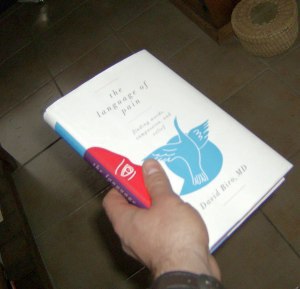
Perhaps a good introduction to the book is in the author’s postscript:
… At its most intense, there is no time to think, let alone try to represent how one feels. … So why bother trying to speak? Why not just close one’s eyes, as I did many years ago in my hospital room, and wait for it to pass? And for those who witness pain, why bother trying to break down the wall of private experience and attempt to share what cannot be shared?
The simple answer is that we must. We must because the consequences of not trying are too great…
We must… but — how?
The goal of the book, if I could summarize it, is to free our tongues so that we can talk about pain (or draw, pain, sing, – most forms of expression fit in this case). Not only talk about it, but talk in ways that help us to understand it better. To deal with it better. And to share in ways that help others understand a little better – doctors, friends, family – the world.
It’s amazing that such a big topic hasn’t been discussed more. Don’t get me wrong – art, visualization, conversations of all kinds have been going on throughout history, and are strongly in the mainstream of medicine today. But the how – how to express pain – it’s a topic we don’t talk about enough.
Dr. Biro has done an excellent job tackling a very difficult topic. He’s done his research – everything from the literature of Charles Dickens and and James Joyce to the paintings of Frida Kahlo to the expressions of cancer and migraine patients.
He’s also navigated the very tricky waters of philosophy. It’s easy to get lost in the never-ending mazes of philosophy, and perhaps he does get a little off-course when he touches on ultimate questions, such as God and pain. But over all, he does a remarkable job sifting through philosophy and coming up with something very practical.
That practical thing is a box of tools that you or I can use to express – and understand – our pain better. He introduces us to different types of metaphor – different ways to approach the topic.
I’m more convinced than ever, after reading The Language of Pain , that being able to express our pain is key. Key to survival, key to understanding, key to treatment – yes, even key to finding cures. As the author writes:
Physicians like me are often humbled by the uncanny sense that some patients have about what goes on inside their bodies. Deciding that something is wrong with them, or, less commonly, that nothing is wrong, patients will blatently contradict the assessment of their doctors and the “objective” data gleaned from sophisticated medical tests. Often they turn out to be right.
But many of us have only experienced the opposite side of communication. The vacant look when you try to explain. That look that says,”I won’t say you’re lying, but I know it can’t be that bad.”
The doctor that brushes you off. The employer that thinks you just want to take a day off.
But as powerful as misunderstanding can be, real communication can be just as powerful when it comes to solutions.
Dr. Biro isn’t exaggerating. If we want to move forward – and fight things like migraine – we must communicate. And it’s a skill we can learn.
It’s taken me a long time to get to this review. Not because I wasn’t interested in the topic, but because this isn’t the kind of book you can scan. It’s not a long book, but it’s not a book to rush through. You need to take the time to understand what is being said, and hopefully let it become a part of you, so that your creative expression starts to show it.
Though it’s not an easy read, it’s certainly not just a book for “artsy” people or clever writers. It’s for every patient in pain – and that’s the point.
I have a feeling this book won’t be read as much as it should be. Then again, more and more people, both patients and professionals in the health care field, do seem to be more and more aware of the necessity of clear communication. If that’s you, this is a great place to start.
Next time you’re having a migraine attack, try warming your hands.
It’s one of the oldest home remedies I ever came up with for migraine. Today, I know that a lot of researchers agree with the idea.
I would go and wash the dishes.
In other words, (having no dishwasher, of course), I would put my hands in hot water.
Today, the "warming of the hands" idea is one of the techniques in biofeedback.
But sometimes something as simple as putting your hands in warm to hot water can help. You could also try putting them in a warm pack like a hot water bottle (no, not in the bottle – you know what I mean).
This doesn’t do quite the same thing as biofeedback (more info in this podcast) – I recommend you try that as well if you haven’t. However, it may be just a little 1% difference that will keep your migraine attack symptoms manageable next time.
Give it a try – warm hands, and maybe a head that’s a little cooler.
What is 1% Thursday?
Every Thursday at Headache and Migraine News (weather permitting) we’ll talk about one measurable, practical thing we can do to make our lives just 1% better. Usually it will be something very easy, sometimes it will be a challenge. Let us know if you try it, or share an idea of your own – and maybe a year from now we’ll see that things have really changed for the better!
On March 17th 2010, the journal Cephalalgia published two studies on Botox from the PREEMPT 1 and 2 trials. These are both phase 3 studies, and it’s still looking good for Botox.
Both of the trials were for chronic migraine sufferers. The patients were given Botox injections every 12 weeks.
The PREEMPT 1 trial found a significant decrease in days with headache and migraine, hours of headache and moderate to severe headache days. Though actual number of attacks were not significantly lessened, the attacks were lessened quite a bit.
The PREEMPT 2 trial also found a significant decrease in headache days within a 28 day period.
More good news – very few patients had problems with the injections (ie side effects) that were significant enough that they stopped the trial.