
Do I need an EEG?
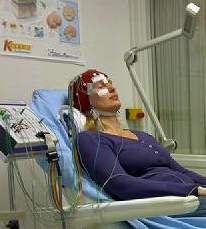
Having an EEG
Photo courtesy of zwolle
An Electroencephalography, otherwise known as an EEG, is a way to measure the electrical activity of the brain (sometimes called brainwaves, though this is not technically correct). Sometimes headache and migraine patients have EEGs done. Should you?
If you’re hoping to positively diagnose your migraine or headache, and EEG probably won’t be a help. Although we have learned a lot about migraine from EEGs, and have noticed abnormal patterns in some people, there is no “common pattern” in everyone. In other words, an EEG probably won’t prove anything. It’s useful to help researchers understand migraine, but not particularly useful in helping individual migraine patients.
There are, however, some cases where an EEG is helpful. EEGs have been used in cases of hemiplegic migraine and basilar migraines, for example.
But EEGs have also been useful because of the close relationship between epilepsy and migraine. Sometimes migraine can be mistaken for epilepsy, and vice versa. An EEG is much more useful in confirming whether or not epilepsy is a cause of the symptoms. Some researchers even use the term migralepsy for a rare disorder that seems to combine the two.
But in this case an EEG will only be ordered if there is reason to believe (from observation) that epilepsy may be a cause of the symptoms.
In the end, in the majority of cases an EEG won’t confirm anything. Observation and response to treatment are far more valuable methods of diagnosis.
Vestibular Migraine - Why the confusion? — Headache and Migraine News Blog
25 October 2008 @ 8:11 pm
[…] to make assumptions. See your doctor and have other causes ruled out first. (Sometimes an EEG is helpful in cases like these). Then you can investigate treatments, which generally are common to most […]
17 October 2010 @ 11:34 am
I started getting migraine headaches at the age of 14. I would get the electricity like sight with the right half of what ever I was looking at not being there followed by vomiting and then the excruciating headache that sometimes lasted for days. During one of my episodes I experienced some amnesia.
These migraines lasted up untill about the age of 40. Then they just stopped occurring up untill almost a month ago (I will be 55 In January), while I was waiting at the Dr’s office. My Dr. was running an hour behind and just at the time I was placed in a room – I started experiencing the sight symptom’s. I found it difficult to even be able to talk to the Dr. without sounding absolutley lost for words at moments. The Dr. gave me a shot of Vico & Demerol even tho I told her that I had no pain. The sight got worse and then disipated. Then this morning (3 day’s lacking a month from then), I started with the visual symptoms again. This time the visual seemed more intense, but I no sooner took a Lorazepam and a half of pain pill which didn’t even have time to take any effect – IT Just stopped!!! Just as quickly as it started. “Thank God”
I’m just hopeing that I’m not going back to having these aweful things again after being free of them for so long.
15 January 2013 @ 12:43 am
Every time I come to your site I seem to find my way to new links and articles. Tonight I came across this one and am wondering if you have any more info. You mention that “EEGs have been used in cases of hemiplegic migraine and basilar migraines, for example.” Do you have any information or links to any studies or other articles about this? My neurologist diagnosed basilar migraines based on signs and symptoms two years ago but neither he nor his partners in practice have any experience actually working with basilar migraine patients. He is learning what he can and so am I but any information that I can garner and potentially pass on is always beneficial. Thanks!
29 May 2013 @ 7:36 pm
I had been suffered with basilar migraines since 2001. Recently it came back and now it is almost 5 weeks. I couln’t go to work or driving anywhere. My most symptoms are dizziness, neck pain, vision blurred. I take verapamil twice a day and Nortriptyline 3 times a day still not helped very much. Is there any medications can help my condition. I just hope someone can help so i will be able to go back to work and gain my life back. Thank you!