
Why Migraine Auras are the way the are
One of the most fascinating things about migraine is the symptom known as aura. More specifically, visual disturbances that sometimes are a part of a migraine attack. Some people have had visual disturbances and no headache at all, though most tend to have the headache and not the visual aura.
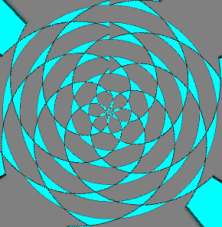 |
About 15% of migraineurs have some kind of aura. They see zig zags, or have a partial lack of vision, or see flashing lights, for example. But why does this happen?
We do know that as a migraine attack progresses, there is a spreading change in the brain – an area where there is a suppression of activity, surrounded by an area with hyperactivity. It’s likely that, as this change spreads over the visual cortex, the instability of the neuron-firing causes the visual hallucinations. Because the effect is spreading, the hallucinations usually change, and eventually disappear. For the migrainuer they may be in one eye, they may be partial or quite detailed, and they can be different as the minutes pass.
But why the weird shapes?
In 1926, psychologist Heinrich Klüver studied the hallucinations that came from patients taking mescaline, a psychedelic alkaloid. He found that there were four patterns that people tended to see, called form constants. The four were tunnels, spirals, cobwebs and lattices (ie checker boards and triangles). These four geometric patterns tend to appear with certain drugs or conditions such as epilepsy and migraine.
So where do these patterns come from? Are you just imagining shapes? Is it something in your body that you’re seeing?
Professor of Mathematics at the University of Utah Paul Bressloff did extensive calculations which seemed to point back to the visual cortex. It looks like the things you see actually reflect how the visual cortex works – how it’s set up. When the neuron-firing gets destabilized for whatever reason, predictable patterns are seen by your brain. It’s like seeing part of a map of your visual cortex. A summary of Bressloff’s findings are here (if you want to go in-depth, read one of his papers, available here in pdf format).
Visual auras in migraine are usually not too serious, but they can become incapacitating for some people. Migraine medication can help to minimize the symptoms if need be.
Thanks to Mind Hacks for pointing to Bressloff’s research.
15 October 2010 @ 10:12 am
Even though I don’t suffer with migraines, per se, I do experience optical migraines (visual auras) from time to time. They usually appear in the form of zigzags or flashing neon lights, sometimes around the perimeter of my vision – other times obstructing my vision almost entirely (normally in one eye only, tho’ occasionally in both eyes. I’m not sure what triggers the onset of these episodes although I’ve noticed bright lights or bright sunshine sometimes seem to influence its arrival. Other times there doesn’t seem to be a connection with anything tangible or definitive.
I’ve found what works best for me is to take two aspirin (at the onset if possible), sit down and close my eyes for five or ten minutes; so far, this routine has always alleviated the problem quite quickly, within 30 minutes or so at the longest. I’ve been having these sporadic disruptions in my vision for 30-plus years, and now at 70 years of age, my eyes are in excellent condition with this one exception.
5 August 2015 @ 5:49 pm
Your symptoms are exactly what mine are, zig zags, clear like jelly. Shaped as an Arc, bright lights will trigger it as well. but now since I just had heart surgery nothing seems to trigger, they just come and as soon as I take an aspirin it is gone in 10 minutes. I have no after effects either..I began having them when I was 52 and very seldom, like once ever few years depending on my stress level. now I am 78 and since surgery they were daily and now are way less..probably weekly or less. But I can’t see much with that Aura my vision is very limited. so hopefully I never get one while driving.
28 September 2012 @ 12:00 am
I have suffered from migraines for the past 40+ years and usually get the jagged lines, sometimes without the headache. I have also found myself suffering from short term memory loss. We used to be able to get Tonopan out here which killed my migraines within 10 minutes, but it seems that medication is no longer available so I can only suffer as nothing else works
15 April 2018 @ 2:26 pm
I’ve had the aura/migraine for a few years. They start out as a small circle of stars in the center of my vision and expand to my peripheral vision. If I catch it quick enough with aspirin, acetaminophen, or ibuprofen I can calm the storm. The further out the ring gets, the worse the ensuing migraine which will throb for days. There’s no pattern, I can’t predict when it’s going to occur. I wish I knew what caused them. I guess I should see a doctor, maybe get a CT scan.