Allodynia: A feature of Cluster as well as Migraine?
A symptom known as allodynia may be an important feature of cluster headaches, research from the Jefferson Headache Center in Philadelphia, USA is telling us.
Over the last few years, allodynia has actually been a hot topic in migraine circles. How prevalent is it, and can it be used to show how successful a treatment will be?
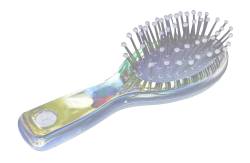 No joke – with allodynia, even brushing your hair can be a very painful task! |
Like about 2/3 of migraineurs, I suffer from this extreme sensitivity and pain when the skin is touch during certain phases of attacks. It probably comes from the hypersensitivity in the brain during a typical attack.
Researchers wanted to get an initial idea how many cluster headache sufferers deal with allodynia. They measured 41 patients for dynamic mechanical allodynia (also called brush allodynia – pain or sensitivity when the skin is "brushed"), and discovered that about 49% of the patients had the symptom.
There was no great difference between age, gender, or even chronic or episodic cluster headache, or how long patients had had cluster.
This may be a real indication that allodynia is a major feature of cluster, and like migraine it may give us clues about what is happening during a cluster attack, and how it can be better treated. It also helps us understand what cluster patients deal with beyond the incredible pain.
(A similar study with similar results was done with migraineurs in 2007 – see Identifying Cutaneous Allodynia in Chronic Migraine Using a Practical Clinical Method).
More on the May 2009 study at Dynamic mechanical (brush) allodynia in cluster headache: a prevalence study in a tertiary headache clinic.