Complex Migraine
Just what is complex migraine? It can be many things! Here is the second in a series on quick tips (the first is here), this one explaining how the term “complex migraine” is often used (or, I should say, abused!).
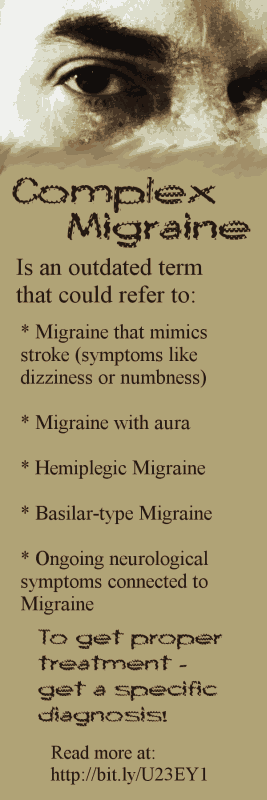

Just what is complex migraine? It can be many things! Here is the second in a series on quick tips (the first is here), this one explaining how the term “complex migraine” is often used (or, I should say, abused!).
Ever since Dr. Frankenstein first saw his monster come to life, the world has been fascinated with the use of electricity in medicine.
Though crude methods have been made famous in the movies, in the last few years transcranial direct current stimulation (tDCS) has become a serious science that has helped people with migraine, chronic facial pain, depression, post-stroke rehabilitation, and more.
It could be argued that this form of treatment is still in its infancy. After all, we still know very little about how it works and how to best use it to treat specific patients.
However, it’s a lot less brutal than you might imagine if you’re thinking of a horror film.
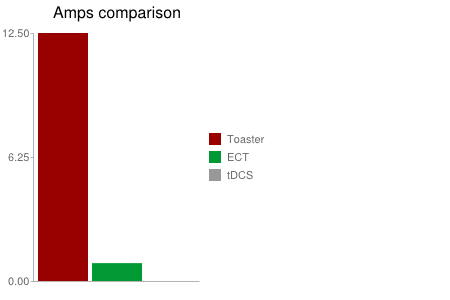
Let’s take for example amperes, the measurement of electrical current. A toaster may have anywhere from 9-16 amps. Electroconvulsive therapy (ECT), on the other hand, which is used to treat issues such as severe depression, typically uses 200 to 1600 milliamperes, or .2 to 1.6 amps.
The current delivered for a lot of the pain treatment we’re talking about today is typically in the range of 1-2 milliamps, or about 0.0015 amps.
Research by Dr. Alexandre DaSilva at the Headache & Orofacial Pain Effort (HOPE) Lab is giving us new insight into how tDCS may fight chronic pain issues such as migraine.
We do know that tDCS treatment can reduce migraine and headache pain. A recent study published in Frontiers In Psychiatry demonstrates how tDCS might work to reduce pain.
Researchers watched what happened during treatment using a specially designed radiotracer and a PET scan. The idea was to measure µ-opioid release.
Without getting into too much detail, you might already be able to guess how this works in the end. Opiates such as morphine impact the same system in the brain, and help fight pain. In short, the plan is to use tDCS to stimulate the natural systems of the body to alleviate pain.
Dr. DaSilva says (as quoted in ScienceDaily):
This is arguably the main resource in the brain to reduce pain. We’re stimulating the release of our (body’s) own resources to provide analgesia. Instead of giving more pharmaceutical opiates, we are directly targeting and activating the same areas in the brain on which they work. (Therefore), we can increase the power of this pain-killing effect and even decrease the use of opiates in general, and consequently avoid their side effects, including addiction.
Dr. James Fugedy has been using tDCS to treat pain for the past few years. He started with fibromyalgia, and has since helped patients with migraine, depression, and chronic daily headache. He writes:
Transcranial direct current stimulation (tDCS) is the most exciting innovation I’ve experienced in 30 years of practicing medicine. … The tDCS procedure itself is simple, but protocols have evolved and results have improved. The numerous but small studies done thus far indicate, but do not yet conclusively prove benefit. Large multi-center studies need to be done to verify outcomes. Still, there is enough evidence at this time to justify clinical use for the treatment-resistant patient, particularly when you consider that there are no negative side effects with tDCS.
Future studies will be designed to provide more solid evidence of benefit, and show us which type of treatment works the best for which type of patient.
We also need to know more about how to help patients long term. How frequent do treatments need to be for patients with chronic headache? For example, could a six-week treatment regime lead to permanent results?
Meanwhile, some doctors are increasingly using tDCS to treat chronic pain. So far, this treatment has an excellent track record. Patients need to start asking their doctors about it, and pushing for further research.
She was putting in her contacts, and all of a sudden got a headache. He got a cold, and got a headache. She woke up with a headache.
Some of this may sound familiar. But when it comes to new daily persistent headache (NDPH), the headache starts but never stops.
 |
NDPH is diagnosed when the headache is constant for at least 3 months.
There are a number of different chronic headaches. Many people have headache all the time, but don’t have NDPH. How is it different from or the same as other headache types?
Remember, there are many types of chronic headache. These are symptoms typical to NDPH.
Sometimes NDPH can go away, though it generally takes several months of treatment.
But very often NDPH is very resistant to treatment. Years go by, and patients do not find relief.
How do specialists try to treat NDPH? Very often treatments are similar to treatments for migraine. And sometimes those treatments work. But there is no typical treatment, and remember we’re searching for better treatments, because many patients have not yet found anything that works well.
 |
Increasingly, patients with NDPH are telling and sharing their stories. If you want to read about the experiences of people with NDPH, here are some places to start:
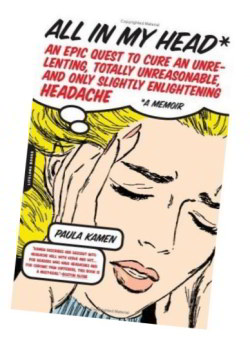
All in My Head: An Epic Quest to Cure an Unrelenting, Totally Unreasonable, and Only Slightly Enlightening Headache by Paula Kamen. (amazon UK)The crazy adventures of over 10 years with NDPH. Also in Kindle format.
When a headache never goes away by Deborah Kotz of the Boston Globe. This article from earlier this year explores the stories of patients and doctors trying to treat NDPH.
Chocolate & Vicodin: My Quest for Relief from the Headache that Wouldn’t Go Away by Jennette Fulda. (amazon UK) (also available on the Kindle) An honest and funny memoir about living with NDPH.
Living with NDPH, a blog from Amy, a mother and NDPH sufferer. Amy is also working on a book – hope we’ll see it soon!
If you’d like to learn more, you can listen to about an hour of questions and answers with Dr. George Nissan thanks to the National Headache Foundation. Listen here:
A new study suggests that migraine and erectile dysfunction may be connected. And the problem involved a surprising group of men.
We’ve talked about migraine and sexuality before. We know there are some important migraine issues related to female sexuality. And of course, these impact men of course!
But this spring a study was released about male migraineurs and erectile dysfunction. By the way, here’s the Mayo Clinic summary of this condition:
Erectile dysfunction (impotence) occurs when a man can no longer get or keep an erection firm enough for sexual intercourse. Having erection trouble from time to time isn’t necessarily a cause for concern. But if erectile dysfunction is an ongoing problem, it may cause stress, cause relationship problems or affect your self-confidence. [Read more]
Now we already know that erectile dysfunction (ED) can be a problem for patients with heart disease, diabetes, obesity, and other conditions. Certain medications can also be a problem, including drugs for high blood pressure, antidepressants, anti-convulsants, NSAIDs, and antihistamines.
The study from the College of Medicine, at the National Taiwan University, took 5763 patients with ED and another 17,289 controls. They then adjusted for some of the most common causes of ED. Then they checked to see who had been diagnosed with migraine.
In the end, they discovered that men who had been diagnosed with migraine were far more likely to have ED.
But here’s the surprise – one group in particular was very likely to have migraine and ED. This group was almost twice as likely to have been diagnosed with migraine compared to the control group. That was men ages 30-39.
Once again, it’s important to talk to a doctor who knows your medical history. As you can see, ED can be caused by certain medications that are common to migraine patients.
Also, in the case of at least one herbal supplement for migraine, the treatment may be helpful for both migraine and ED. Pycnogenol has been studied as a migraine and ED treatment.
If you’re dealing with these two issues, you’re certainly not alone. Talk to your doctor and develop a strategy that works.
Study abstract: Migraine and erectile dysfunction: evidence from a population-based case-control study.
via: Is There an Association Between Migraines and Erectile Dysfunction?
Back in 2007 we did a series in the free ezine HeadWay about various types of headache.
 |
That information is generally accurate 5 years later (although researchers and doctors continue to discuss how some of the categories could be changed).
So if you want to educate yourself and sound smart with all your friends, why not print out those issues (or stick them on your Kindle) and read them through?
Here they are, for your enjoyment: