Shades for Migraine
Here I am – in honour of the Shades for Migraine campaign today. I’m wearing my Theraspecs!


Here I am – in honour of the Shades for Migraine campaign today. I’m wearing my Theraspecs!
Sooner than expected, the migraine medication currently known as galcanezumab finished its phase III trials, and is preparing to apply to the FDA in the United States later this year.
Galcanezumab is a medication from Eli Lilly, in the new class (and much anticipated) of migraine medications known as CGRP inhibitors. There are a number of these medications approaching the finish line in their trials.
So how did galcanezumab perform in these trials? Very well, and as expected from previous trials.
The charts below show how many “migraine days” were eliminated by using 120mg of galcanezumab as opposed to a placebo. For episodic migraine, as tested over 6 months: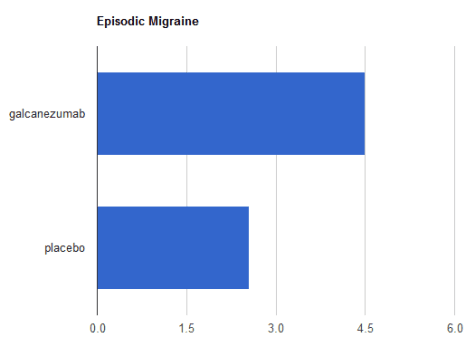
For chronic migraine, testing over 3 months, the results were equally positive, cutting almost 5 migraine days per month: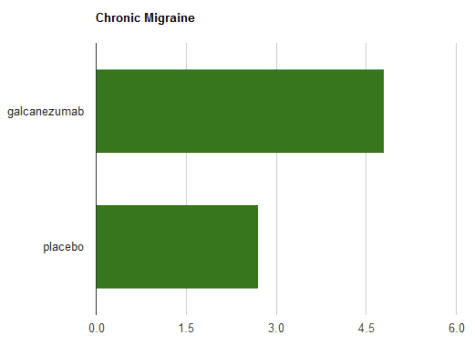
This means that the new drug could give patients over 55 more migraine-free days per year.
With these positive results, Eli Lilly will be submitting what is called a Biologics License Application to the FDA, which is basically a request to be allowed to sell their product throughout the country. After that, they will begin applying in other countries worldwide. This will start in the last half of this year.
Official press release from Eli Lilly: Lilly Announces Positive Results for Three Phase 3 Studies of Galcanezumab for the Prevention of Episodic and Chronic Migraine
Last month the announcement was made that gammaCore, a non-invasive vagus nerve stimulation (nVNS), was approved by the FDA for the treatment of episodic cluster headache.
We’ve been watching the development of gammaCore for the last few years. It’s already been approved in quite a few countries around the world, but this is the first approval in the United States.
This device has shown promise not only in the treatment of cluster headache, but also migraine. Although this recent approval was for episodic cluster, there is some evidence that vagus nerve stimulation may help patients with chronic cluster and chronic migraine.
This particular device is used directly by patients, and is hand-held – small enough to carry along. It’s non-invasive and painless – simply held against your neck for 90 seconds.
At the time of writing this post, this device is not yet available in the United States. However, you can check out the gammaCore US website for updates.
Meanwhile, here is a video from a chronic cluster headache sufferer (he also suffers from SUNCT), explaining how he has found gammaCore helpful.
It’s interesting to see stories that hit the headlines about migraine that are almost – useless.
Maybe I should rephrase that. The information is useful in some way, but it’s not really the amazing life-changing information that the news outlets may be looking for.
So Men’sHealth says,”Your Weight Might Be Giving You a Headache” with the subtitle But can slimming down help?
And get this one, from the DailyMail – Why being a healthy weight is ONLY way to beat migraine (I read the article – I’m still not sure why it’s the “ONLY” way – no explanation about why people with a healthy weight have migraine, or why people have found other solutions – but – it does – catch your attention!).
There were many, many articles posted. So I guess we all need to get healthy, and then our migraine attacks will disappear.
So what is the actual news?
The research was published in the journal Neurology, analyzing 12 studies related to migraine. Adjusting for age and gender, the researchers set out to see if weight was a factor. And of course, it was.
People who were obese (BMI 30 or higher) did indeed have an increased risk – they were 27% more likely to have migraine.
Underweight? With a BMI of less than 18.5, people had a 13% higher risk of migraine than people of normal weight.
(By the way, here’s a handy tool to calculate your body mass index (BMI).)
 Is this useful information? Yes, but it does not necessarily mean that losing/gaining weight will cure migraine.
You’ve already figured it out, because readers of Headache and Migraine News are smart. Why were underweight/overweight people more likely to have migraine disease? Just because their weight was off? Or could there be an underlying problem causing both? Is it possible that people who have chronic migraine have trouble getting proper exercise? Could medications be causing weight fluctuation? What if treating the migraine first would actually help you reach a normal weight?
The study author, B. Lee Peterlin, is also smart, and made this observation:
It’s not clear how body composition could affect migraine. Adipose tissue, or fatty tissue, secretes a wide range of molecules that could play a role in developing or triggering migraine. It’s also possible that other factors such as changes in physical activity, medications, or other conditions such as depression play a role in the relationship between migraine and body composition.
[Both Too Much, Too Little Weight Tied to Migraine]
Of course, we’ve talked about migraine and weight gain before. And yes, there’s no denying that proper nutrition and an active lifestyle will help your health overall – and are great migraine-fighters.
Although there is no proof that you should just lose/gain weight and you’ll be fine, there is good evidence that treating the whole person will help with migraine and a host of other issues.
In other words, as we say regularly around here – treat the migraine (that might just help you get to a proper weight!) and treat the weight issue (which may actually help alleviate migraine!). Be aware of the health issues involved. Don’t just focus in one one thing. Focus on general over-all health.
I’m sorry if your Aunt Martha (who always nags you about your weight) just sent you an unbalanced news story about migraine and weight. Don’t tell her off again, and don’t jump on the scale and go into a sudden panic. But do be aware that treating migraine is more than just taking a pill. It’s about fighting for your overall health.