News
Podcast: Migraine and Generalized Anxiety Disorder
[display_podcast]
The main article we discussed was Adults with migraines have triple the prevalence of generalized anxiety disorder from ScienceDaily.com. You can read the abstract of the actual study here: Untangling the Association Between Migraine, Pain, and Anxiety: Examining Migraine and Generalized Anxiety Disorders in a Canadian Population Based Study.
Check the Mayo Clinic for more on generalized anxiety disorder symptoms.
I didn’t mention this other article, but there’s an interesting related study, also from the University of Toronto: Research shows dramatic link between inflammatory bowel diseases and anxiety disorder
And the article I mentioned about the Migraine World Summit: The Unexpected Reason You Should Pay Attention to the Migraine World Summit
The Unexpected Reason You Should Pay Attention to the Migraine World Summit
There’s a very important event coming up that you need to know about – The Migraine World Summit 2017! Why (you may ask)?
Last year’s Migraine World Summit was a tremendous success! I had the privilege of being both a speaker and a learner. The information was cutting edge and very practical – I’m still going through the material.
But this year is going to be even better!
For those of you who don’t know, the summit will be bringing together experts from around the world – and I mean top, world renowned experts. They will be sharing the latest information, and their years of experience, with everyone who attends.
And you can attend, online, for free (as long as you have tickets. Which are free).
Compared to last year, the production quality is going to be raised significantly, and there will be even more great speakers (36 in all) from the forefront of migraine research and treatment.
Now, why should you attend? Of course you want to be on the inside track of information for new treatments and research. But there’s another, maybe even more important reason, why you should get your free tickets.
I spoke with Carl Cincinnato, the host of the Migraine World Summit, via Skype. He has an ambitious vision for the summit and its future.
Imagine if the summit starts getting the attention of more researchers, governments, universities, and other people with major influence. The Migraine World Summit could become more than just a tool for patients and doctors – it could become a movement.
What if people with money started realizing the need for funding migraine research? What if governments started making research a priority? What if more places of learning and research started cooperating?
You can help get their attention just by attending via your computer or smart phone. The more people, the better!
And now for the details: The event is taking place between the 23rd and 29th of April (if you get tickets, you are free to “attend” whichever workshops you would like to). As a bonus, after you sign up, you’ll get to see a free video with highlights from last year (yes – I’m in it!).
To sign up for free, visit this page.
Be a part of the movement – it’s time to fight back!
Migraine + Migraine-related = Expensive
Insurance companies, governments, and in the end – we the migraine patients – spend a LOT of money on treatment. And it’s those who are suffering the most, and who are the most disabled, who are going to have the highest expenses.
Dr. Kenneth E. Thorpe from Emory University in Atlanta, USA, recently put together a paper showing a different perspective on the cost of migraine in society.
Very often we look at the cost of migraine treatment as an individual thing – days lost to migraine, medications taken, time in the hospital, due to migraine . . .
But this overlooks something very important – migraine does not always come alone. There are a number of other diseases and disorders that tend to come along with migraine. These are known as “comorbid” conditions.
Here’s an example from Dr. Thorpe’s paper, using USA stats only. In 2015, about $5.4 billion dollars were spent in the USA for treating chronic migraine (yes, that’s only chronic migraine – this does not include all the other types of migraine, never mind related headache disorders). 5.4 billion!
Now, what does it cost for chronic migraine + comorbid conditions? Over $40 billion.
Wow. Just taking the 5.4 billion per year – let’s cure migraine and use the money to solve world hunger! (Ok, I’m being simplistic – but seriously, there are things we could do with 5.4 billion…)
So what are these comorbid conditions? Some of the top ones included mental and mood disorders, arthritis, hypertension and heart disease.
As disability increased, so did the cost. And disability was worse with more comorbid conditions (remember, many chronic migraine sufferers have several comorbid conditions).
Dr. Thorpe made the important observation that we really do need to treat the “whole person”. It may be easy to give someone with a “headache” a “pill”, but migraine patients need treatment that takes into consideration other conditions and their own health risks and medical history.
For us as patients, we need to be aware of other conditions and symptoms that we may forget about because we’re focused on the PAIN of migraine.
Dr. Dawn C. Buse offers this note for her fellow doctors and specialists:
In general, people with more comorbid conditions use greater health care resources including medical appointments, hospitalizations, medications, and even phone calls to providers. Comorbidities are more common in chronic migraine. They make treatment more complicated and are associated with worse outcomes. I recommend that all providers screen for common comorbidities and treat or refer as appropriate.
In other words, doctors should be aware of the possible comorbid conditions, and should think about treatments that can help the whole person.
Read more details from NeurologyAdvisor: Comorbidities Have a Significant Impact on Chronic Migraine Health Care Costs
A “Smart” Non-Drug Arm Patch to Fight Migraine
A new form of migraine treatment is in the testing phase – a new kind of migraine fighting patch. Of course, putting a patch on your body for medical reasons, even to fight migraine, isn’t anything new. Of course, we’ve had mixed success in the past – take the famous example of Zecuity, which shows no signs of returning to the market soon.
But these are mostly drug options. How about a non-invasive, non-drug patch? One that you can actually control from your smart phone? How would that work?
The company is Theranica, and the Nerivio Migra patch is the product currently being tested.
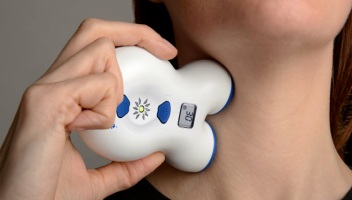
Recently I updated you on the Cefaly device, which is billed as a external trigeminal nerve stimulator (e-TNS). Various similar devices are available or are being tested for migraine.
Although we don’t completely understand how these devices fight pain, one theory is the “pain inhibits pain” theory. The idea is that pain in one part of the body may actually inhibit pain in another part.
But who wants to hammer their finger, to stop a migraine attack? No thanks. So – what if we could trick the body into thinking that there was pain, even though we couldn’t feel it?
Now things get really complicated, but that is one way of looking at nerve stimulation.
However you look at it, there is evidence that such devices can lower your migraine pain (without causing more pain!).
Now unlike Cefaly, this new patch is not a preventative, but an abortive. It’s intended to stop individual attacks. But what else sets it apart?
Well, Theranica asked some questions – how can we make a device that’s more discreet – less bulky – so that it could easily be hidden and used anywhere? How can we make sure there is no pain, or muscle “twitching” when the device is used? And how can we avoid parts of the body that are often the most sensitive during a migraine attack (head and neck)? And most importantly, how can we create a device that will provide long term relief?
And so, Nerivio Migra was born. Designed as a wireless patch, placed high on the arm, it tries to balance being portable, easy to use, and effective.
A preliminary study has already been completed, showing promise. Compared to sham treatment, patients were far more likely to report a reduction in pain – in many cases, a complete elimination of pain. The results were easily comparable to taking sumatriptan, a common migraine-targeting medication.
The study was small, and there were some problems with it, so it’s time for a (hopefully) more robust study. The study is not yet recruiting participants, but will be soon. If you live in the United States or Israel, and suffer from episodic migraine, you may be eligible. For more details and contact information, just go here.
Whether or not Nerivio Migra is ultimately successful, it represents more thoughtful progress and research into non-drug, non-invasive treatments for migraine. Stay tuned.
For a detailed discussion of the medical theories behind Nerivio Migra, see Acute Migraine Pain Relief via Remote Electrical Nerve Stimulation – a systematic analysis