Migraine and TheraSpecs on “The Doctors” (video)
Recently “The Doctors” discussed migraine – and even mentioned TheraSpecs, the migraine-fighting lenses that we’ve discussed here before.

Recently “The Doctors” discussed migraine – and even mentioned TheraSpecs, the migraine-fighting lenses that we’ve discussed here before.
Researchers at the University of California have discovered a new genetic link to migraine – and a rare sleep disorder – that may get us closer to the cause of migraine than ever before.
First, a note. Last week on Facebook, Damien Higgins posted the following: There was Migraine News today that made many of the international news channels and you havnt even mentioned it!!! this page is not exactly on the ball, is it!!!http://news.sky.com/story/1085914/hope-for-migraine-sufferers-after-genes-find
Well, I have no particular excuse for not mentioning this story sooner, other than to say that this website has not yet reached the level of perfection that I or Damien may want!
That being said, many stories hit “international news” and are really hardly worth mentioning, in my opinion. Honestly, a lot of migraine news is old news, poorly reported, blown out of proportion, or in reality not useful. And sometimes it’s worth taking the extra time to research the news a little more before repeating the same thing here.
Regarding genetics and migraine, we’ve discussed a lot of discoveries here. In fact, back in 2010 we talked about a similar news story – Found: Genetic Link to “Basic” Migraine
We’ve also talked about something critical to understand – Migraine: Why Genetic Studies haven’t Solved all our Problems.
In Damien’s defence, however, this news story is worth mentioning. And I won’t claim that the Sky news report is overblown, although most migraineurs are probably tired of seeing the same old headline – “Hope for Migraine Sufferers…”! 🙂
 |
First, we need to be cautious about claiming that we’ve “finally found the genetic cause of common migraine”. This is not the first time genetic mutations have been linked with common forms of migraine. There are some unique things about this study which we’ll discuss in a moment, but it’s a tricky thing to prove that a genetic mutation is the cause or even related to “most” migraine attacks.
Researchers were actually looking at two conditions: Migraine and Advanced Sleep Phase Syndrome. This sleep syndrome causes you to go to sleep earlier (ie in the evening) and get up earlier (ie between 1 and 5 am).
Researchers found two families in which many members had both conditions (in this case, the sleep disorder would be called familial advanced sleep phase syndrome).
To make a long story short, it was discovered that two related gene mutations were highly associated with both conditions.
Now mice who had one of these mutations (CKIδ-T44A) were also researched. These mice had a lower threshold for cortical spreading depression (CSD), a storm that sweeps across the brain that is considered a key part of the migraine chain reaction. In other words, they were more likely to get CSD.
These mice were more sensitive to pain, and astrocytes (certain neurological cells) showed increased calcium signalling, which may relate to parts of the migraine reaction as well.
Now the research on CKIδ-T44A and the mice and migraine is not new. Neither is the link between these two mutations and advanced sleep phase syndrome. However, the link with the two mutations and the two conditions – migraine and advanced sleep phase syndrome is.
You might be a little underwhelmed that we’re just talking about two families, and a rare sleep disorder, and just another two mutations after we’ve already linked others with migraine.
However, this is how a lot of good research starts.
These mutations are linked. And the most important finding may not be the mutations themselves, but what they point to.
For one thing, they both influence a special protein known a connexin 43 (Cx43). Even if these particular genetic mutations don’t turn out to be common in migraineurs, there could be other factors that are impacting Cx43, and so that might be the direction that future research takes.
I’ve intentionally avoided getting into all the specific mechanisms of these mutations in order to focus on the practical implications. But if you’re interested in the more technical aspects, you can read the study abstract: Casein Kinase Iδ Mutations in Familial Migraine and Advanced Sleep Phase and a discussion of the findings at Gene Mutations Tied to Migraine, Sleep Disorder.
Podcast: Play in new window | Download
Today’s podcast covers some recent migraine news. Here are some of the links mentioned:
Our recent poll asked the question – Do you feel that your migraine/cluster/headache attack triggers changed over time?
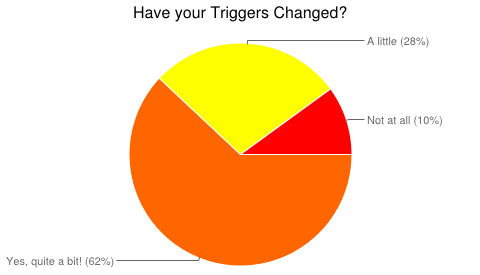
So yes, triggers do change over time.
Migraine triggers have actually been in the news a lot lately. One headline told us Study Confirms Patient Difficulty in Identifying Migraine Triggers. The study was extremely small – 9 people – confirming what most of us know… that it’s sometimes hard to nail down migraine triggers.
What triggers an attack tends to be multifactoral – many things combined. If wine is a trigger, for example, it may still only trigger an attack if combined with another trigger, such as second hand smoke, or a change in sleep schedule.
Life is complex, we know it.
So, the lead author of the study, Dr. Timothy T. Houle, suggests that patients should be involved in formal experiments, rather than trying to find triggers on their own. After all, many patients do believe that one thing is a trigger, when another thing is really to blame. This can mean bad treatment, and lack of success in fighting migraine.
Who wouldn’t want well-designed experiments that could accurately pinpoint a trigger?
But where are these to be found? Co-author of the study, Dana P. Turner, M.S.P.H., admitted that even physicians have trouble identifying triggers. Remember, life is complex.
Although I’m happy for any help, I’m not holding my breath to see an amazingly accurate trigger-identifier. In spite of the lack of objectivity and scientific know-how of us patients, we know something better than anyone else – and that is, our own bodies.
I’ve heard from many, many, many migraineurs who have successfully fought migraine by identifying and eliminating triggers. No, it’s not the only thing we need to do – it’s not a cure-all. But it is part of the current treatment of migraine that is helping some.
So keep an open mind, and keep a migraine diary.
And don’t forget to take our new poll (right sidebar)!
Read more: Migraine Triggers Tricky to Pinpoint
Migraine Triggers: Track them Down
Levadex, an inhaled version of dihydroergotamine mesylate (DHE), has been rejected again by the FDA in the United States due to manufacturing concerns.
Levadex was recently at the centre of a deal worth almost a billion, when Allergan bought MAP Pharmaceuticals, the developers of the drug. Just over a year ago, with MAP at the helm, Levadex was not approved by the FDA due to concerns about the inhaler.
Allergan is probably best known for manufacturing Botox, also used for migraine treatment.
DHE is an old migraine treatment, but many still find it helpful. Often given in a hospital intravenously, many patients hope that an inhaled version will be a help at home.
Patients with chronic daily headache may also benefit from Levadex, assuming it gets to the market.
And it probably will. Allergan is hoping to apply for approval again before the end of the year.