We’ve talked a lot about the pros and cons of Botox for migraine here. One of the biggest challenges with Botox treatment is that it is, in many ways, still in its infancy.
Photo courtesy Armin KübelbeckThat is, we still have a lot to learn about who will benefit most, what dosage to use, and where the injection sites should be. But we do know that treatment should vary depending on the patient.
After a frustrating experience trying to pass on the treatment of an 83 year old woman, Dr. Alexander Mauskop at the New York Headache Center takes the time to VENT – and to remind doctors that there is no such thing as a one-size-fits-all Botox treatment.
Doctors, it’s worth whie to read a little about Dr. Mauskop’s experiences. He has used Botox with many patients for 22 years, and takes the time to keep track of how well it works, how often it should be administered, and how.
Although more clinical trials do need to be done, it’s helpful to at least read about the experiences of other doctors.
If you could get rid of just one day of migraine agony, would you? Of course you would. But what’s the best way to do it?
One of the new treatments for migraine that is being developed, and even used today, is vagus nerve stimulation.
Now this type of treatment has actually been around for a while. A device is implanted that stimulates the vagus nerve, which runs on two sides of the body from your brain stem through your neck, chest, and abdomen. This type of treatment is used for hard-to-treat cases of epilepsy and depression.
But the latest thing is non-invasive vagus nerve stimulation, which means no surgery, and no implants.
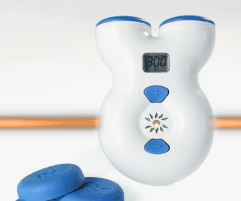
A company known as gammaCore has developed such a device, which is already sold in Europe and Canada, though not yet approved in the United States.
So far, the device has certainly helped people with both migraine and cluster headache. And the bonus is that the treatment is very well tolerated, with few side effects. Plus, it takes less than 2 minutes to use.
A new study of the device showed some improvement in patients (see Chronic migraine headache prevention with noninvasive vagus nerve stimulation). After 2 months, almost 10% of the patients had a 50% treatment response. They basically had a day or two that were migraine-free, which otherwise would not have been. (These were patients chronic migraine, so originally they had at least 15 days with migraine attacks per month, some with attacks almost every day)
The interesting thing about this study was that patients continued to improve over 8 months. After 6 months, patients had 6-7 more days symptom-free. And after 8 months, 7-8. Would the improvement continue? It looks like it might.
So researchers are preparing for longer and better trials.
To see what using the device is like, take a look at this video:
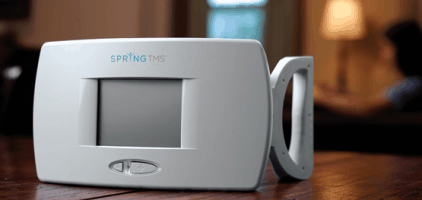
It’s been a while since we talked about SpringTMS, so it’s time to bring it up again. SpringTMS is a transcranial magnetic stimulation (TMS) device which you use as soon as you feel a migraine attack coming on.
Devices like SpringTMS are increasingly popular because they lessen your need for medication, they’re easy to use, and there are few if any side effects. Of course the main benefit is that, in many patients, it stops the symptoms of migraine. Read more about SpringTMS here.
The device is currently available in the USA and the UK. I’m not sure about its availability or the logistics of getting it elsewhere, but if you have experience outside of the UK or US leave a comment.
In the UK, SpringTMS is available by prescription through a cost sharing program. It’s available at certain clinics in London and other locations in England. For more information, visit the official UK website here. The company is eNeura.
In August, Kerrie Smyres did the legwork for us to get information about obtaining (and paying for!) the device in the USA. Essentially, SpringTMS is available by prescription under a rental program, and so the price will vary depending on the rental plan. There may be reimbursement through your insurance plan.
But I will let you read Kerrie’s post for more details. Some of the information is applicable in the UK as well, so check it out if you’re interested: Your Guide to Getting a Spring TMS
We’ve talked often about magnesium for migraine, as one of the best treatments for migraine available today. As with any treatment, however, it works for some people and not for others.
Of course, in spite of our clumsy comparisons of the body with a machine or a computer, each human body is actually incredibly unique and complex. So nailing down the “whys” is sometimes almost impossible.
Fatigue: An early sign of magnesium deficiencyPart of the reason may have to do with the level of deficiency in each person. A magnesium deficiency may contribute to migraine attacks in some patients, but not all actually have a deficiency.
There are many other factors as well. The type of magnesium, when you take it, what you take it with (for example, if you’re taking magnesium for migraine, avoid taking it along with calcium) (more tips here).
Dr. Alexander Mauskop at the New York Headache Center has shared some interesting observations, which point to the need for further research into magnesium for migraine.
Here are some of his thoughts:
Magnesium seems to help less than 50% of migraine patients (Dr. Mauskop feels that this is because the rest do not absorb the magnesium).
About 90% of patients with an actual magnesium deficiency improve with magnesium supplements.
The other 10% require regular infusions of magnesium, and “these infusions are often life-changing”.
Now there is another interesting new observation here. Of these last 10%, two patients recently noticed a significant difference between two methods of infusion. Dr. Mauskop explains:
These patients tell me that when we give them an infusion of magnesium by “slow push” over 5 minutes they get excellent relief, but when they end up in an emergency room or another doctor’s office where they receive the same amount of magnesium through an intravenous drip over a half an hour or longer, there is no relief.
A likely explanation is that a push results in a high blood level, which overcomes the blood-brain barrier and delivers magnesium into the brain, while during a drip, magnesium level does not increase to a high enough level to reach the brain.
Essentially, and this seems to be the case sometimes with sumatriptan as well, two patients may take the same amount of medication or magnesium, but one has a “quicker” dose. The one who has the “quicker” dose responds better than the other patient.
While we wait for more studies to be done (and a good question is – does generic plain old inexpensive magnesium get the funding that the fancy new medications do?), how can we use this information?
First, if you have tried some magnesium supplements without success, consider actually being tested for a magnesium deficiency. If you are deficient, it will definitely be worth trying more magnesium options, even if it takes time.
Second, remember that there are a lot of options when it comes to magnesium treatments. Try some different supplements, and consider talking to your doctor about infusions.
Finally, if you do receive infusions, ask about the 5 minute “slow push” method that Dr. Mauskop mentions. It may do more to stop those symptoms than the slow-drip method.
Many people aren’t even aware of the confusion and controversy surrounding butterbur as a migraine preventative. But after listening to this podcost – well, at the very least you can join in the confusion!


 Now this type of treatment has actually been around for a while. A device is implanted that stimulates the vagus nerve, which runs on two sides of the body from your brain stem through your neck, chest, and abdomen. This type of treatment is used for hard-to-treat cases of epilepsy and depression.
 The device is currently available in the USA and the UK. I’m not sure about its availability or the logistics of getting it elsewhere, but if you have experience outside of the UK or US leave a comment.