Everyone knows about headache, nausea, visual auras – maybe even vertigo or congestion. These are all possible symptoms of a migraine attack. And then there are comorbid disorders, such as depression or IBS.
But how often do we talk about neck pain when we talk about migraine?
Of course we talk about it – sometimes. But a recent study questions whether we should be talking about it a lot more.
Some researchers in Brazil have been probing into the link between neck pain and migraine. One of their recent studies was published in the Journal Headache.
The question was not whether or not migraine patients have neck pain. It was more a question of disability.
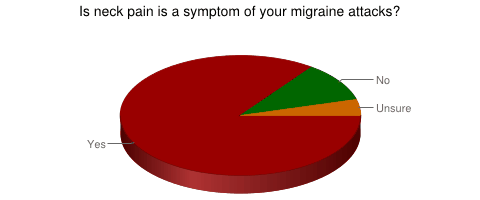
But let’s go back a step. In 2010, in a study entitled The Prevalence of Neck Pain in Migraine, researchers discovered that neck pain was actually more likely to accompany migraine than nausea.
As the migraine attack progressed, nausea (if present) tended to increase, but so did neck pain.
Also, the more attacks a person had per month, the more likely they were to experience nausea. But the neck pain also increased, remaining more common than nausea.
Now, of course, if you’re nauseous and your neck hurts, usually the neck pain will be ignored and the nausea will be treated, because you can function somewhat with neck pain (if it isn’t too severe), whereas nausea can keep you from just about any activity.
Now, back to the more recent study. The study discovered that not only was neck pain present, but it was disabling. For some people it was more disabling than others, but 69% of those with episodic migraine had some disability from neck pain, and 92% of those with chronic migraine had some disability from neck pain!
So what have we learned so far? Neck pain is associated with migraine. More than a co-morbid condition, neck pain seems to rise and fall with individual migraine attacks. Neck pain is also worse for those with chronic migraine.
Research over the past few years, including the recent study, are showing not only that migraine and neck pain are related, but that neck pain seems to be a symptom of migraine. In fact, it may be a very common symptom of migraine. On top of that, it seems to be a significantly disabling symptom of migraine.
A lot of questions remain, of course. Is the migraine attack contributing to the neck pain, or vice versa? Or could the neck pain and migraine rise from a common cause? The answer may be a mix of all three, and research in Brazil and elsewhere continues to investigate just where this neck pain is coming from and what its characteristics are.
Meanwhile, those of us with migraine need to pay attention to neck pain as a possible symptom of our migraine attacks. It’s something that should find its way into migraine diaries and discussions with our doctor.
Researchers in 2010 also discovered that patients delayed treating migraine when neck pain was present. It’s possible that our lack of understanding of the relationship is keeping us from recognizing a migraine attack. If you pay attention to neck pain symptoms, you may be able to recognize a migraine attack faster and treat it earlier.
What about you? Do you experience neck pain with migraine attacks? Tell us about it!