
Shades for Migraine
Here I am – in honour of the Shades for Migraine campaign today. I’m wearing my Theraspecs!


Here I am – in honour of the Shades for Migraine campaign today. I’m wearing my Theraspecs!
Athletes are in significant danger of over using over the counter “painkillers”, endangering not only their careers in sport but also their future in general.
 Friends and family of athletes, whether athletes on the high school football team or athletes at the Olympics, need to be aware of the incredible pressure that athletes are under to take over the counter drugs such as ibuprofen, naproxen, and paracetamol / acetaminophen, and many stronger versions. We’re not talking about powerful banned performance enhancing drugs here, but the danger is still real.
Many in sport are now coming out in the open to talk about the destructive results of taking so many pills and injections. Overuse of these medications can, in the end, actually keep you from healing properly. Kidney problems, bowel diseases (which can lead to cancer), chronic headache, cardio-vascular problems, and general dependence are only a few of the possible consequences. Many athletes end up in serious depression.
Why would an athlete end up taking a painkiller every single week – maybe even several times a day, in spite of these serious risks? There are a number of reasons:
As you might imagine, it’s very easy to fall into the trap of taking these over the counter drugs constantly.
For those who care about athletes, be sure to talk about this issue and watch for signs of depression.
For athletes themselves, you need to ask yourself:
It’s sad that sports, that should be about being healthy and at your best, continually seems to pressure athletes to abuse their bodies for short term gain. And this is not a matter of an athlete just trying to take fewer pills or injections. It’s a complex, serious issue that requires serious thought be leadership in the field of sports, from doctors who treat athletes, and especially from the family and friends of the athletes. Society needs to be aware of the dangers of this kind of drug use.
If you have become dependant on painkillers or other drugs/alcohol, there is help available. Search online for treatment in your area, talk to your doctor, or people in your community, church, or even family and friends who may have recommendations.
The BBC has been doing some reporting in this area – here are some places to go for more information:
Preeclampsia is a high blood pressure condition in pregnancy. It has come up here at Headache and Migraine News more than once for a couple of reasons. First, pre-eclampsia can cause a pulsating headache, as well as symptoms such as dizziness and nausea.
Although these symptoms may be similar to migraine attacks, migraine itself has also be connected to preeclampsia. Women with a history of migraine may be at increased risk for preeclampsia.
If you’re experiencing new headache symptoms late in pregnancy, it’s critical that you have a checkup as soon as possible. The headaches may be an indication of a number of conditions, some more dangerous than others.
Recently at the New York Headache blog, Dr. Alexander Mauskop pointed out another interesting connection between migraine and preeclampsia. There is a certain treatment that is similar in both – magnesium.
As the American Family Physician as pointed out, “Studies have shown the effectiveness of magnesium in eclampsia and preeclampsia, arrhythmia, severe asthma, and migraine” (see Magnesium: Top of the List for Migraine).
Magnesium is taken as a daily supplement by many people with migraine, but it’s also given in the emergency room to stop severe migraine in its tracks. It’s also given in cases of preeclampsia and eclampsia, to stop convulsions and allow for a more normal delivery of the baby.
So the question is – is it just that magnesium happens to be effective for both migraine and preeclampsia, or is this actually an indication of abnormally low levels of magnesium in some patients?
Dr. Mauskop looks at a recent study that searched for factors that may predispose women to preeclampsia. The study did not check for low magnesium levels. As he writes:
If preeclampsia responds so well to magnesium, it is possible that these women have chronic magnesium deficiency. Magnesium deficiency predisposes people not only to migraines, but also to heart attacks and strokes. The test that should have been done is red blood cell (RBC) magnesium since 98% of magnesium is inside the cells or in the bones. The most commonly used serum magnesium level measures the remaining 2% and is highly unreliable.
He goes on to recommend that women who have suffered from preeclampsia or eclampsia be tested, and that they generally try to lower their risk for vascular problems:
If you’ve suffered from preeclampsia or eclampsia, in addition to reducing other risk factors for vascular problems – control your blood pressure, sugar and cholesterol, stop smoking if you smoke, lose weight, and exercise, you may also want to ask your doctor to check your RBC magnesium level. If the level is low or at the bottom of normal range, take a magnesium supplement. A good starting dose is 400 mg of magnesium glycinate taken daily with food. If subsequent tests show no improvement, the dose can be increased to 400 mg twice a day and even higher.
Read more from Dr. Mauskop here: Preeclampsia can have lasting effects on the brain
It would be interesting to see a study of magnesium levels in women who have had preeclampsia, and to hear from you if you’ve suffered from both preeclampsia and migraine, and have found magnesium to be an effective preventative.
Many people use the Medisafe app to remind them to take their medications. But even if you’ve been using it for a while, you may not be aware of some of the extra features for both patients and doctors that Medisafe has developed.
If you’re not familiar with Medisafe, check you Here is a method that is helping people remember to take their meds!
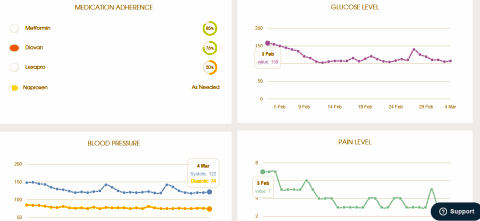
For one thing, you may not know that Medisafe can connect with other health information on your device. Medisafe can collect all the information so that you and your doctor can see your progress.
Your doctor can then see your information at a glance, as below. Doctors, you can see a demo of how this works at Medisafe for Providers.
But is my information safe?
Medisafe is very serious about keeping your information private. They are HIPAA (Health Insurance Portability and Accountability Act) compliant, which means that Medisafe and any related organizations and technologies use a number of safeguards to keep all your information private wherever it’s stored and however it is transmitted.
For more on HIPAA compliance, see this Summary of the HIPAA Security Rule.
They’re also ISO 27001 certified, meeting international standards of security.
Medisafe has always been very interested in making their technology easy to use, and this is being extended through the use of iCap.
What if you could just take your medications as you normally do, without actually having to enter the information into a smart phone? That’s where iCap comes in. An iCap is actually a “smart” pill bottle cap. You don’t press buttons or enter numbers, you simply open and close the bottle as you normally would.
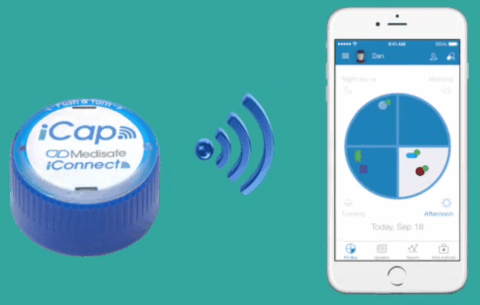
The iCaps use bluetooth to connect to the Medisafe app. The information can then be sent (automatically or otherwise) to a trusted family member, and even to your doctor. The technology can even send you or a friend or doctor text messages and email reminders.
But that’s not all. The cap actually lights up. That’s right — it alerts you, so that you’ll know if you’ve taken your medication or supplement or vitamin or whatever it may be.
iCap can even be used for migraine medication taken “when needed”, such as a triptan medication.
Don’t be embarrassed if you sometimes forget to take your medication – your doctor will not be shocked or surprised. However, with technology like this, you can really stay on track much more often and really see which medications are helping and which are not.
Check out the iCaps right here.
We have been using Medisafe in our family for quite some time now. Start with the app – it’s free. But be sure to take a look at some of the other things you can do with it.
While you’re working at improving your treatment, check out 7 Ways to Stick to Your New Treatment (or not).
We’re always on the lookout for a better way to cool down the throbbing pain of a migraine attack.
There are many ways to “cool your head”, and they all have their pros and cons. Of course there are the old ice packs – some better than others. But the temperature can’t be controlled, and it’s hard to keep them in place.
There are “wearable” ice packs too – better, because they will stay in place and are adjustable.
Also there are professional grade cooling systems, such as the ThermaZone Continuous Thermal Therapy Device that gives constant cooling. An excellent option, but a professional device comes at a professional price.
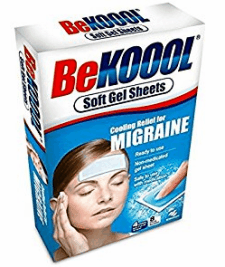 But if you want an inexpensive solution, gentler than an ice pack, it’s the simple, wearable “cooling pads” that are getting the rave reviews (at least, some brands).
These pads generally come filled with a gel, and you can press them on your forehead or the back or your neck (they have a gentle adhesive), and they’ll work in some cases for hours.
Probably the most popular and highest rated is the BeKoool brand (just say the name a few times and you’ll feel better 😉 ). One of the reviewers from last year wrote this:
I seriously wish I’d heard of these years ago. They feel similar to using a Badger Headache Soother Stick, except the results last for hours instead of just mere seconds). These gel sheets are FAR superior to a washcloth or ice pack; they are practically weightless for starters (any pressure on my head is unbearable once a migraine has started), and they maintain the same cool temperate for a full 8 hours, unlike a washcloth which only stays cool for five minutes, or an ice pack which starts off too cold and needs to be wrapped, then needs to be continually unwrapped to maintain the same coolness over the next hour or two (and the last thing you want to do when you have a migraine is move, because that just makes your head throb worse).
If you want to stay elevated, or if your pain is minor and you want to move around, or if you roll around a lot when you’re in pain, these are amazing because they stay in place wonderfully! I’ve gone to sleep wearing them (I have a hard time falling asleep when my head hurts and these help so much) and even though I toss and turn, these strips are still in place when I wake up hours later.
These are by no means a miracle cure – they don’t stop my headaches or migraines. However, if I use one while waiting for my Relpax to kick in, it makes the wait FAR more bearable. I will definitely be stocking up on these. I’m honestly considering getting bangs just so I can wear these discreetly out in public without getting strange looks! No, I’m not joking, that’s how much I love the way these feel!
[source]
The main complaints come from two sources – one, the scent. Which is why BeKoool for Migraine is great because reviewers tell us they have no scent. (The MQ brand, on the other hand, apparently has a nasty scent. Avoid that one!)
Some people also find that the adhesive is irritating. That isn’t the case for most people, but you may want to try out a brand before you buy 50 boxes to have on hand.
Also well reviewed is the WellPatch Migraine & Headache Cooling Patch (which claims to last up to 12 hours) and the Coralite Cooling Headache Pads.
By the way, the company that makes BeKoool specializes in this type of medical pad. They also make pads for soothing fever in children.
These are an excellent drug-free way to soothe symptoms. I can also see them being a great surprise gift to send to a friend who gets frequent headaches.