Every month I try to give you a chance to see at a glance which recent articles have been the most popular with visitors to Headache and Migraine News. So, here we are in September!
The posts are listed most popular first, but the three in bold were social media hits, with the most “likes” on Facebook:
Many people wonder just how much migraine affects their ability to think. And one thing is very clear – it does. Researchers who have completed a new study are calling doctors to pay more attention.
There is no doubt that migraine affects your ability to think during an attack. That means trouble thinking, remembering, processing information, and learning in general (see Is Your Brain “Slower” During A Migraine Attack?.
That much is obvious to anyone who has had an attack.
But the other question is, how much does migraine affect your thinking between attacks? We do know that migraine, as a disease, affects your life all the time in various ways. But what about cognitive skills? Does your ability to think go downhill over the years?
Now the general consensus seems to be – no. As a matter of fact, some research has shown that migraine patients have less decline in this area than other people. And that’s because you read intelligent articles like those here at Headache and Migraine News. (Hah! Sorry, couldn’t resist. Then again, maybe all the research we have to do does help!)
But the research is still weak in this area, which is why the studies continue.
A study from Italy in the Journal of Headache Pain was published last month, studying cognitive and psychological symptoms in migraine patients. The patients were not taking medications for migraine, and they were not having an attack when they were tested.
So – according to this study, do migraine patients (in this case, migraine without aura) have cognitive problems in between attacks?
The answer? Yes – some.
Interestingly enough, the study did not find a lot of psychological problems in these patients, such as anxiety and depression. At least, nothing drastically different from the general population. We do know that these types of problems are highly associated with migraine – but those with major depressive disorders were excluded from the study.
Cognitive problems were not severe, but they were there. Problems with memory, attention, ability to plan, and so forth, were all affected.
These problems were significant enough to show up in the study, but not significant enough to be “clinical”, which may explain why they aren’t noticed more often.
The study also found that when migraine attacks were more disabling, there were more cognitive problems between attacks.
The researchers concluded:
Drug-naïve MwoA patients are characterized by subtle cognitive dysfunctions and low percentage of behavioural symptoms. The results support the importance of searching for subclinical cognitive disturbances in patients with MwoA, who deserve to be followed-up to verify whether they develop clinically relevant disorders over time.
Dr. William Young, who was not involved in the study, commented that it would be wise for doctors to check for various causes of cognitive problems. “Check the thyroid, check blood chemistries, and make sure he or she doesn’t have a vitamin deficiency.” Also, once you’ve ruled out other causes – treat the migraine! The “thinking” problems may go away as migraine is successfully treated.
Do you feel that your “thinking” ability has gone downhill since your diagnosis with migraine? Has your doctor done any tests to try to find the cause?
Earlier this week we looked at the history of a strange term for migraine – brain hives. In the past, doctors have sometimes thought of migraine as an allergy, partly because of the way that certain things tend to trigger an attack.
Although this view may be thought of as overly simplistic, we also saw that more recent research has actually shown a connection between allergy and migraine.
But, brain hives? (By the way, here’s a blogger who used the term brain hives a few years ago – wondering if they made “brain scratchers” to relieve symptoms!)Photo courtesy John Benson What about the connection to hives? What exactly is hives?
Like migraine, much of the time we don’t know what triggers an attack of hives.
Also known as urticaria, hives may be triggered by eating a certain food, by an insect bite, or by contact with some other irritant.
Histamine is released, and the capillaries in the body leak fluid. As the fluid accumulates, a rash appears on the skin. The skin swells, and itchy pink or red round or oval “wheals” or welts appear.
Some cases may last for a few hours, other cases can last for weeks, or even become chronic, although we’re not sure why. Read more here: What are hives?
Earlier this year at the Migraine Summit, respected migraine researcher clinician Dr. Stephen Silberstein was discussing the migraine chain reaction. Interestingly enough, he brought up the term “brain hives”. Listen to what he said:
We still don’t know exactly what triggers the migraine attack, where the pain comes from. Some people believe, with a lot of good evidence, that in many ways, migraine is like brain hives. What are hives? Chemicals are released from nerves on the skin, we get swelling and itching.
We think in many ways, migraine may be like that, chemicals are released from nerves lining the surface of the brain. They produce a chemical reaction, swelling, leakage end up perhaps to pain of migraine. Very simple analogy to think that migraine is brain hives.
Dr. Silberstein’s main point was not that migraine is an allergy – I want to be careful not to misrepresent him. However, his point was that there are similarities between the migraine chain-reaction and the hives chain-reaction.
As the authors of “Managing Your Headaches” pointed out, “allergy shots will not protect you against migraine.” It’s easy to jump to a simplistic answer – just give me an allergy test and a pill. It doesn’t work that way for migraine (and sometimes not for hives either!).
Their thoughts were:
A great number of foods have been implicated in triggering migraine. It is important to understand that when we talk about these food triggers we are not implying that are you are “allergic” to the particular food involved. Allergies imply an immunologically mediated trigger. When foods trigger migraine, they generally do so by influencing the head pain pathways that we have discussed previously. Allergy shots will not rid you of migraine or your susceptibility to your migraine triggers.
But doctors have been so quick to point out the differences, that they’ve sometimes missed the connection. If a migraine patient is generally more “sensitive” to triggers, wouldn’t it make sense that an allergy – even a mild intolerance – could be a part of the story?
Maybe doctors of past generations had a point. There may be a closer relationship to allergies and migraine than we usually think.
The link between food and contaminants and migraine is also controversial. Just how much should patients focus on avoiding triggers? How much does it help? Can you over do it?
But the fact remains that patients are often helped dramatically when they avoid a food or change hairspray. And some have even been able to discover the connection through allergy testing.
So let the research continue – not just in the labs, but maybe in your own home.
Strangely enough, the term “brain hives” has a history to it, when it comes to migraine. And I just heard the term again this year.
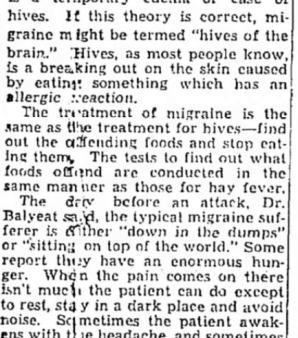
June 23rd, 1934. In the Salt Lake Tribune, an article about some of Dr. Balyeat’s theories.Almost a century ago, Dr. Ray M. Balyeat was a big name in migraine research in the United States. Dr. Balyeat made some very modern observations about migraine, which would hold up well today.
But Dr. Balyeat’s specialty was actually allergies. In fact, he had a successful clinic for patients with allergy and asthma.
So what did he see? Of course he began to notice similarities between migraine and allergic reactions. He saw incredible improvement in patients who simply avoided certain food triggers.
Now it’s easy to jump to the conclusion that just because a food triggers migraine attacks, that you’re “allergic”. It doesn’t seem to be that simple.
However, researchers continue to notice the connection between allergies and migraine.
We do know that, for example, migraine patients who are tested for common allergies seem to improve when they eliminate the offending foods from their diet (see Migraine and Food Allergy? New Study…). Food intolerance or “delayed” allergies are also an interesting field of research. These are problems that would not show up in a typical allergy test.
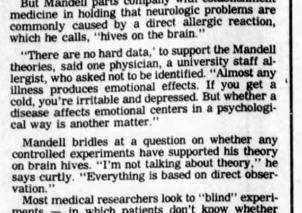
Dr. Marshall Mandell, featured in the Reno Gazette-Journal, 17 April 1978.A generation later, another allergist from the USA was promoting a “controversial discipline” known as clinical ecology – that is, finding the contaminants that are causing an illness.
Dr. Marshall Mandell believed that most migraine attacks were in fact caused by “cerebral allergies”, such as chemical hypersensitivities (hypersensitivity – certainly a popular word in migraine research today!).
Though some of Dr. Mandell’s ideas would be dismissed today as they were then, he did take patients seriously when other doctors wrote off their headaches as “all in your head”. He used vitamin B, still commonly used in migraine treatment. And he recognized many environmental triggers that research has continued to bring to light.
All of this takes us into a world that is much more complicated than obvious allergic reactions causing migraine. But there’s no doubt that there is some kind of a connection. Were these doctors from the past really on to something?
Later this week we’ll take a closer look at hives, and migraine, and see what connections we can find.
Is your child, who has migraine attacks, also tired and depressed? I don’t mean just during a migraine attack, but a lot of the time.
Empty Desks: How many students are missing school due to chronic illness this September?It is critically important to be aware of other symptoms besides the obvious ones, like headache and nausea. Why? Because, as with adults, migraine doesn’t always come alone, it brings its “friends”.
A recent study on children with myalgic encephalomyelitis (also called chronic fatigue syndrome) highlights the need, once again, to be aware of other symptoms.
In the study, patients with both ME/CFS and diabetes were studied. What other symptoms/disorders/diseases did they have? It may not be surprising that many also had migraine. Other common symptoms were depression, weakness, muscle pain and the obvious one – fatigue.
Almost half of the patients were dealing with general tiredness for a year before they were actually diagnosed with ME/CFS.
Another interesting finding – many had had an infection (such as infectious mononucleosis) in the two year period before their diagnosis with ME/CFS.
In other words, if your child just doesn’t seem to be getting his or her energy back, there may be a good reason. Their infection may have be related to longer term problems.
It’s very hard, especially in children, to recognize symptoms – especially when there are a bunch of symptoms happening together. It’s easy to focus on the most debilitating ones.
But the more we can be aware – both as children and adults – of the various symptoms we may be experiencing, the shorter the path will be to good treatment.


 But the other question is, how much does migraine affect your thinking between attacks? We do know that migraine, as a disease, affects your life all the time in various ways. But what about cognitive skills? Does your ability to think go downhill over the years?