A new delivery system for migraine medication was just approved in the USA, and it’s been largely flying under the radar. Maybe that’s because people aren’t sure why they would need – or want – to shoot powder up their nose.
Actually, you’re going to want to take a closer look at this medication, so let me take a moment to explain.
Choosing a Medication
Some people have been helped, others not so much, by triptan class medications. But for abortive medications, triptans remain one of the best options in general for migraine.
But some people can take a triptan and find it doesn’t work – then take a different triptan and find that it does work. Perhaps more surprising, they can take a medication in one way with no success, but then take the exact same medication another way and find that it works.
And so researchers often start with a tried and true triptan medication – sumatriptan (a familiar brand is Imitrex) – and try to find a better delivery method to get it to stop the pain, and to stop it as soon as possible.
So there are a lot of options for sumatriptan – tablets, injections, nasal sprays … even a skin patch.
Pros and Cons of Nasal Sprays
Nasal sprays have some advantages. No needle, and no swallowing, for one. But maybe the most key advantage is that they get the medication into your system fast. This is important because – well, you know you want to end the pain as soon as possible. It also tends to be the case that stopping an attack early is easier than stopping an attack later.
But nasal sprays aren’t perfect. Here’s the problem – first, they may be easy to use, but they aren’t foolproof. It is easy to – not spray it quite right (see The Top 12 Mistakes People Make With Nasal Sprays).
Even with an expert sprayer, liquid can leak out and you won’t get the full effect of the medication.
So – Why Powder?
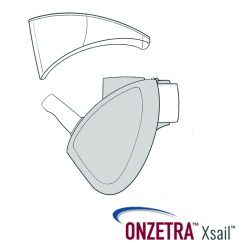 Finally, after all that explanation, we get to spraying powder up the nose. Why would I want that?
The new medication is called Onzetra Xsail, from Avanir Pharmaceuticals. The medication was formerly known as AVP-825, based on the OptiNose delivery system (we talked about it here in 2014).
Here’s the advantage with powder – instead of leaking and spraying all over the place, it immediately sticks to the inside of your nose and gets absorbed (think throwing flour onto a wet sponge). That means less waste, less room for error, and an extremely fast-acting medication.
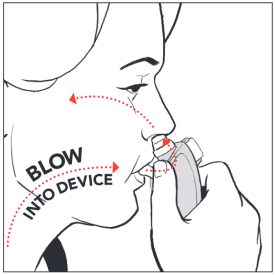 Now the developers of Onzetra Xsail have actually done something pretty clever as far as use goes. You don’t technically push a button to spray something up your nose. The problem with that is, you never know if you should exhale, inhale, hold your breath… Instead, you actually blow into the device. This automatically pushes the powder where it needs to go, and you’re done. 2-3 seconds.
This is the “Xsail Breath Powered Delivery Device” (now you get it, right? Xsail?), and it seems to be a great idea, and it seems to be working well for the patients who have tried it. It would be great to see similar innovations for other migraine medications.
Now that Onzetra Xsail has been approved, we begin the process of getting it out to patients, and of course there are other countries which will need to approve it. This could take a while, but the process is in motion.
For more information:

 On the other hand, the AAN is not recommending Botox for tension-type headache (even it it’s chronic) or for episodic migraine.
 But how does this medication compare to migraine-specific medications, such as the ever-popular sumatriptan?
 And imagine this scenario, described by Katharine Sanderson in
 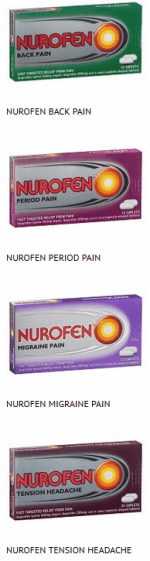 This was the Nurofen line, including Nurofen Period Pain, Nurofen Migraine Pain, Nurofen Tension Headache – all products that appeared to be specially formulated for a specific thing.