It’s time to take a look at the articles that have been the most popular with you, guests to Headache and Migraine News. As always I’ve put in bold the three articles that have the most “likes” on Facebook. In this case, it’s the top three posts in general.
I hope you’ve enjoyed the Migraine World Summit! I don’t know how many people attended, but I hope it will go a long way to helping migraine patients around the world. If you didn’t catch all the interviews (I didn’t!), you can still purchase the full library of interviews. It’s a lot to absorb, and I’m looking forward to learning more from the summit in the weeks ahead.
The onset of silent migraine symptoms can cause a lot of worry, even if the symptoms themselves aren’t too debilitating – which they can be. But are these symptoms something to worry about, or can they be safely ignored?
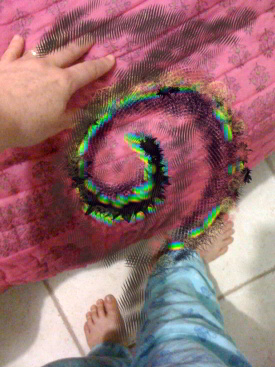
Migraine aura illustrated by Kathryn GreenhillMigraine aura is not just one thing. Many people are familiar with visual auras, which may include seeing flashing lights, zig zags or patterns. Visual auras can even include a partial loss of vision – either an area of reduced vision or even temporary blindness.
But silent migraine symptoms are not limited to visual auras. An increased sense of smell, trouble speaking or finding the right word, even hearing things – there are a variety of possible symptoms.
The important thing to remember is that these symptoms are temporary, increasing for a few minutes and then typically lasting an hour or less.
Once commonly known as silent migraine symptoms, the condition is now considered a type of migraine called typical aura without headache. It is possible in this type of attack to have more than one symptom, but there is no muscle weakness, fainting or dizziness (if there is, it may still be migraine, but it’s a different type of migraine. For example migraine with brainstem aura).
The symptoms may be an inconvenience, or they can be extremely disabling. Either way, they can be scary because they can look a lot like stroke and other diseases.
If your symptoms are new, or there is a change in symptoms, it is critical to see your doctor right away. When the aura is very short, or very long, or includes blindness over half of your field of vision, your doctor will be particularly concerned and will need to rule out other causes.
Getting Rid of Silent Migraine Symptoms
As strange as the condition may seem, it is not uncommon. And it is a type of migraine. Depending on how disabling the symptoms are, your doctor will discuss with you the risks and benefits of treatments.
As a type of migraine, typical aura without headache is generally treated the way other types of migraine disease are treated. There are many drug and non-drug treatments available – for an introduction, see How to treat a migraine.
Should you be worried? If these symptoms are new or have changed, yes, you should be concerned. If ongoing, your doctor can help you manage them or even eliminate them with proper migraine treatment.
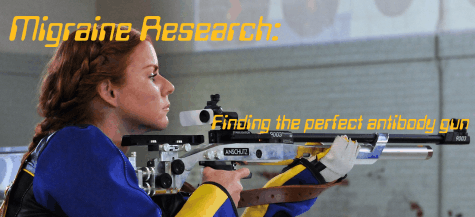
A huge emerging area of medical treatment is in the study and use of antibodies. Imagine if you were a sharpshooter, with a special gun that could attack certain cells or substances in the body. There would be little or no collateral damage – the bullets would only hit what you wanted to hit.
Now imagine that you could use that gun (an antibody medication) to shoot the messengers that were carrying around pain signals in your body – and in this way you could stop a headache in its tracks.
Sounds great, doesn’t it? That’s what many many researchers around the world are thinking too. Though a relatively new field, it’s growing quickly, especially in conditions such as cancer and immune related diseases (such as Crohn’s disease and multiple sclerosis).
And, of course, this type of treatment has caught the imagination of migraine specialists. But the question becomes – what should the antibody gun shoot at?
The use of monoclonal antibodies directed against CGRP (calcitonin gene-related peptide neurotransmitter) is probably the hottest area of research in the area of antibodies for migraine. CGRP is the target, and this type of medication is showing a lot of promise as multiple companies race to get it the market. (Read more: The “Revolution†in Migraine Treatment (Dr. Peter Goadsby))
But there are other targets that are being researched. For example, Dr. Yu-Qing Cao of the Washington University Pain Center has carried out research (funded by the Migraine Research Foundation) on cytokines and chemokines as new targets for the antibody sharpshooters.
Cytokines and chemokines? What are they? Well, they’re types of protein in the body that coordinate immune responses. They’re handy to have around, but when they get out of control they can cause inflammation and degeneration on a neurological scale.
There are certain proteins that may rise in headache patients – could we shoot them down and stop the headache?
In a trial with mice (you have to start somewhere), the results of the proper antibodies were promising.
Drugs are already in the pipeline that could hit some of these migraine-specific targets, such as clazakizumab which is being developed for arthritis pain.
So this is what many researchers are doing – finding possible targets, looking for links with headache and migraine, and finding ways to shoot them down to keep them from causing problems, such as PAIN.
It’s coming up on Friday – the Migraine World Summit! And you’re not going to want to miss it.
Don’t want to travel and be in a room with other people’s perfume and cell phones? Don’t worry, this is a virtual event. Which really allows the summit to include migraine experts in various fields from around the world. You’ll get to hear some of the cutting-edge research about migraine treatment, cluster headache treatment, and more.
Worried about the ticket price? After all, this is a 6 day event, from the 15th to 20th of April. No worries, you can attend for free – get your tickets right here.
Here are just a few of the big names that are going to be at this summit:
Dr. Merle Diamond: speaking on emergency room treatments and status migraine, as well as other treatments.
Dr. Richard Lipton: speaking on chronic migraine, risk factors, and the question of a “cure”.
Dr. Alexander Mauskop: speaking on drug-free migraine relief.
Professor Lynn Griffiths: speaking on clinic trials and genetics.
Dr. Stephen Silberstein: speaking on hemiplegic migraine and innovative new migraine treatments
Those are only a few of the topics from a few of the 30+ speakers.
And guess what? I’ll be there too! You can see me interviewed, speaking about my own migraine experiences and some of the things I’ve learned in 13+ years of researching migraine. The full schedule can be found here.
Let me say, I have a whole new respect for people who are interviewed all the time – it’s not easy (yes, it was pre-recorded)! I’ve been obsessing over everything I forgot to say, or shouldn’t have said and so on and so on – so be kind. 🙂
But seriously, don’t go to hear me, go to hear some of the many people that I have a lot of respect for. You may not agree with everything they have to say – listen critically, but also listen with an open mind.
I’ll be there watching too. I won’t be able to hang around for every session, but thankfully there are videos, MP3s (yay! No computer screen!) and transcripts being made available for a reasonable price as well. I’ll be getting the VIP Access Pass, so maybe we’ll be able to talk more about all the information from the summit in the future.
Again, get your free tickets right here: Migraine World Summit. Once you get your tickets, you’ll also see what’s available in the special passes.
I’m looking forward to “being with you” as we explore the latest in headache and migraine research and treatment!
It was over 10 years ago that Ortho-McNeil Neurologics, Inc. set up the “migraine simulator” as a part of their campaign to promote Topomax. Now, the makers of Excedrin, Novartis, have used the power of virtual reality to make a new migraine simulator with a difference.
This time, it’s not a simulator for the general public. It was make specifically for certain people. The Excedrin website explains it this way:
Because every migraine is personal, Excedrin® collaborated with each sufferer to mirror exactly what she usually goes through. A virtual reality specialist programmed the simulator to replicate each sufferer’s individual migraine symptoms, whether they were sensitivity to light or aura (or both).
Excedrin® then asked the non-sufferers to take on a regular day with a migraine.
Obviously the headache pain could not be duplicated, so the focus was on visual aura (which not all migraine patients experience) and sensitivity to light (much more common).
Do not miss watching this video. If you’ve experienced either of these symptoms, or even other similar symptoms, it may even be hard for you to watch. But I’m guessing many of you will want to show this to a friend and/or family member. It shows, in a unique way, how powerfully disabling migraine can be.
Thankfully, the simulator can be taken off. My favourite part is “I’ve got to stop … that … “