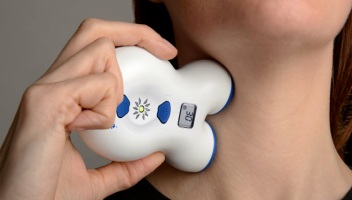
Last month the announcement was made that gammaCore, a non-invasive vagus nerve stimulation (nVNS), was approved by the FDA for the treatment of episodic cluster headache.
We’ve been watching the development of gammaCore for the last few years. It’s already been approved in quite a few countries around the world, but this is the first approval in the United States.
This device has shown promise not only in the treatment of cluster headache, but also migraine. Although this recent approval was for episodic cluster, there is some evidence that vagus nerve stimulation may help patients with chronic cluster and chronic migraine.
This particular device is used directly by patients, and is hand-held – small enough to carry along. It’s non-invasive and painless – simply held against your neck for 90 seconds. Using the gammaCore deviceIf you would to see a video showing exactly how gammaCore is used, see More Research on Vagus Nerve Stimulation (and a video).
At the time of writing this post, this device is not yet available in the United States. However, you can check out the gammaCore US website for updates.
Meanwhile, here is a video from a chronic cluster headache sufferer (he also suffers from SUNCT), explaining how he has found gammaCore helpful.
It’s interesting to see stories that hit the headlines about migraine that are almost – useless.
Maybe I should rephrase that. The information is useful in some way, but it’s not really the amazing life-changing information that the news outlets may be looking for.
And get this one, from the DailyMail – Why being a healthy weight is ONLY way to beat migraine (I read the article – I’m still not sure why it’s the “ONLY” way – no explanation about why people with a healthy weight have migraine, or why people have found other solutions – but – it does – catch your attention!).
There were many, many articles posted. So I guess we all need to get healthy, and then our migraine attacks will disappear.
So what is the actual news?
The research was published in the journal Neurology, analyzing 12 studies related to migraine. Adjusting for age and gender, the researchers set out to see if weight was a factor. And of course, it was.
People who were obese (BMI 30 or higher) did indeed have an increased risk – they were 27% more likely to have migraine.
Underweight? With a BMI of less than 18.5, people had a 13% higher risk of migraine than people of normal weight.
Is this useful information? Yes, but it does not necessarily mean that losing/gaining weight will cure migraine.
You’ve already figured it out, because readers of Headache and Migraine News are smart. Why were underweight/overweight people more likely to have migraine disease? Just because their weight was off? Or could there be an underlying problem causing both? Is it possible that people who have chronic migraine have trouble getting proper exercise? Could medications be causing weight fluctuation? What if treating the migraine first would actually help you reach a normal weight?
The study author, B. Lee Peterlin, is also smart, and made this observation:
It’s not clear how body composition could affect migraine. Adipose tissue, or fatty tissue, secretes a wide range of molecules that could play a role in developing or triggering migraine. It’s also possible that other factors such as changes in physical activity, medications, or other conditions such as depression play a role in the relationship between migraine and body composition. [Both Too Much, Too Little Weight Tied to Migraine]
Of course, we’ve talked about migraine and weight gain before. And yes, there’s no denying that proper nutrition and an active lifestyle will help your health overall – and are great migraine-fighters.
Although there is no proof that you should just lose/gain weight and you’ll be fine, there is good evidence that treating the whole person will help with migraine and a host of other issues.
In other words, as we say regularly around here – treat the migraine (that might just help you get to a proper weight!) and treat the weight issue (which may actually help alleviate migraine!). Be aware of the health issues involved. Don’t just focus in one one thing. Focus on general over-all health.
I’m sorry if your Aunt Martha (who always nags you about your weight) just sent you an unbalanced news story about migraine and weight. Don’t tell her off again, and don’t jump on the scale and go into a sudden panic. But do be aware that treating migraine is more than just taking a pill. It’s about fighting for your overall health.
Welcome to this month’s edition of your favourite posts from the last three months! The most popular posts come first, with the three in bold having the most “likes” on Facebook. Hope you find the useful!
Women, Migraine, and Stroke: The link between migraine and stroke is nothing new, but recent research is making it a hot topic once again…
Candesartan for Migraine: Recently a HeadWay subscriber mentioned a treatment that has been working well for her…
A Quick Update on Cefaly for Migraine: The Cefaly device is a non-invasive, migraine-fighting external trigeminal nerve stimulator (e-TNS) device used daily to prevent migraine attacks…
Chemotherapy Headache: Chemotherapy headache is very common in cancer patients, although the chemo itself is not always the cause, or only cause, of the pain…
A few years ago, concerns about migraines and blue light was riding a wave of research into everything from computer screens to the sun at the beach. But does blue light actually make migraine pain worse? Is it dangerous? Are some types of light better than others? And where does green fit in?Photo courtesy The Western Sky
New Scientist explains how the results of a study in 2010 were later questioned:
Six years ago, Burstein and his colleagues studied migraine in sufferers who are blind, either due to the loss of an eye or retina, or because of retinal damage. They found that people who had some remaining retinal cells had worse migraines when they were in brightly lit environments, and that blue light seemed to have the strongest impact.
The finding caused a flurry of excitement, and the promotion of sunglasses that filter out blue light. But since then, a special class of cells has been discovered in the retina that process only blue light – and seem to be saved from some types of retina damage that can cause blindness. So there was nothing special about blue light in Burstein’s study – it was just that it was the only type of light his volunteers’ eyes could process.
Blue light can actually be good – or bad – for migraine patients. As a high-energy visible wave, blue light actually helps with alertness, and can elevate your mood. It helps keep your body keep in rhythm with its environment. All these things are very important for migraine patients.
But as you may have heard, too much blue light at the wrong times can really mess you up – put your rhythm out of whack and even damage your eyes. Hence the concern about “screens”, computer screens and smart phones, especially after dark. This has led to the popularity of blue blocking covers and computer glasses. Many operating systems now have built in options to allow you to “warm” screen colours at sunset (for example, Windows 10 now has “Night Light“, iOS has “Night Shift” … I still like the free f.lux. And don’t forget glasses such as Theraspecs).
But the benefits of these software answers are still in doubt – maybe it’s just better to cut down the screen time!
Cutting out blue light to treat migraine took another hit, a new migraine and colour study was done (with some of the same researchers involved from the 2010 study).
In the new study, published in 2016, blue was not the stand-out light at all. Of four colours (blue, red, amber, and green), blue and red both tended to make migraine pain worse to a similar degree, with amber close behind.
Remember, generally speaking, migraine patients avoid light – the colour may make a difference, but they would simply prefer darkness.
So the surprise is not that these colours bothered the migraine patients. The surprise was that green actually decreased the migraine pain.
Yes, a certain type of green seemed to decrease the pain almost as much as the other colours increased it!
So should we all just wear green glasses?
Not so fast. The green light actually did increase some migraine symptoms similar to the way white light does (throbbing and muscle tenderness). And although green was better than most, migraine pain “spreading” was still reported with the green light.
As with many studies, it’s important that this is another step in our knowledge of migraine, not that it gives us an instant answer, so that we can go out and buy a new product that will solve all our problems.
That being said, if you must have a little light in the room during a migraine attack, try green and see if it’s better.
Also, other studies have indicated the benefits of certain tints for sunglasses and contact lenses.